A project misses its deadline. A customer leaves. A machine fails. A campaign spends the budget and produces almost nothing.
The review begins with a reasonable question: What happened?
But the question rarely remains open for long. Someone was careless. Someone did not communicate. Someone lacked urgency. Someone should have known better.
Once the organization has a name, it also has a remedy. Give feedback. Add training. Put a note in the performance review. Replace the person if the failure was serious enough. The meeting ends with the satisfying feeling that accountability has occurred.
Then a different person encounters the same incentives, the same missing information, the same overloaded process, and the same failure happens again.
The organization did not solve the problem. It purchased narrative closure at the cost of understanding.
In her episode of The Unfolding Thought Podcast, Factor.AI co-founder Lindsay McGregor describes what she calls the blame bias: our tendency to explain poor performance through the character of the person closest to the outcome, even when the surrounding system did more to produce it.
That insight is often softened into a pleasant leadership slogan: blame the system, not the person. But the implication is more demanding than the slogan. System thinking does not remove accountability. It expands accountability beyond the person with the least power to change the conditions.
Blame is what organizations use when they want the appearance of accountability without the work of learning.
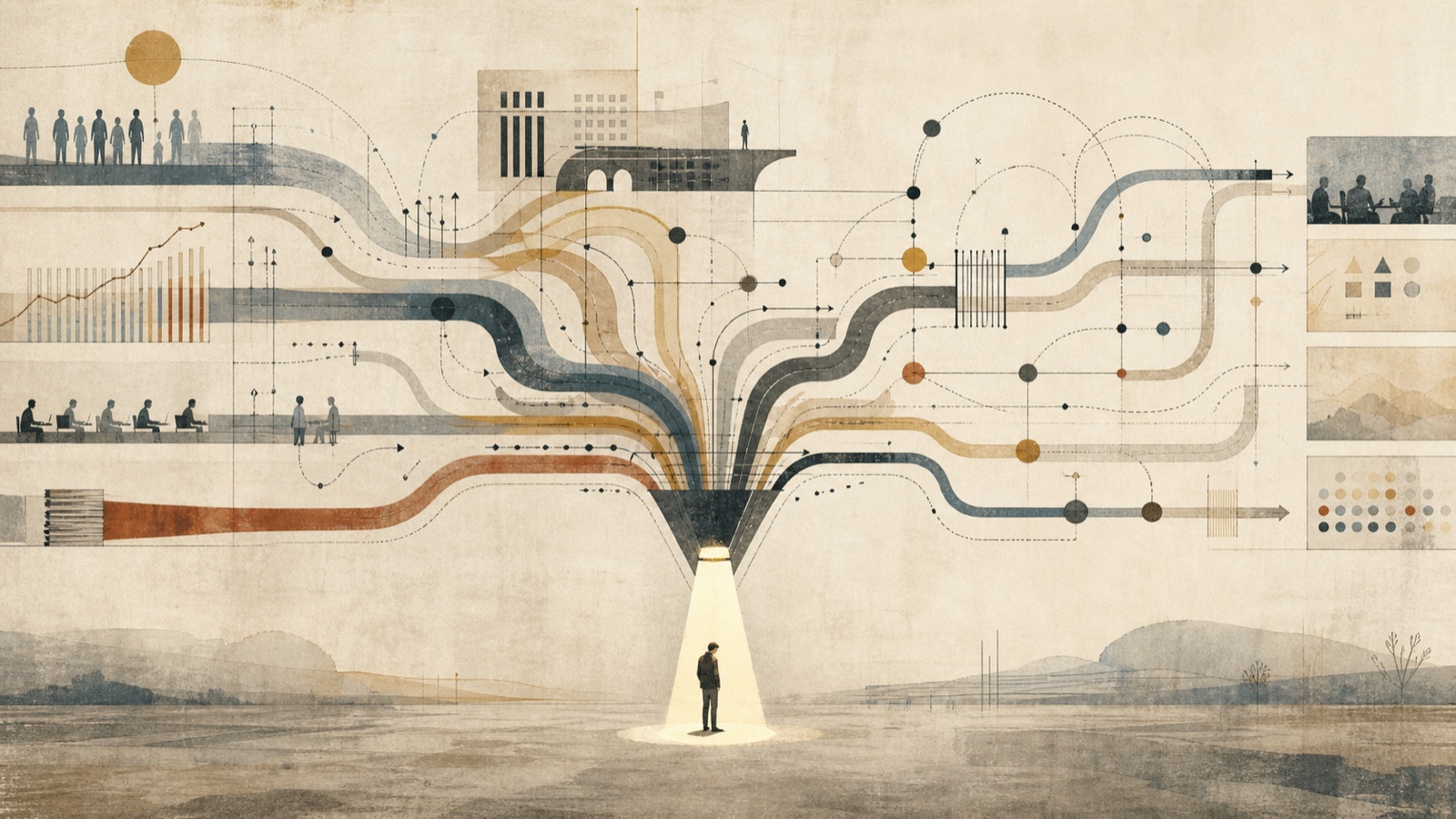
Blame compresses the causal field
Every meaningful organizational outcome has more causes than can fit comfortably into a meeting.
A missed deadline may involve a poor individual decision. It may also involve an unrealistic estimate, a sales promise made without delivery input, shifting priorities, a dependency no one owned, incentives that rewarded saying yes, and a reporting process that made trouble visible only after recovery was impossible.
Blame compresses that causal field into a person. It converts a difficult investigation into a familiar moral story: a responsible person would have produced a different result.
Social psychologist Lee Ross gave the fundamental attribution error its name in 1977. We tend to overestimate stable traits when explaining another person’s behavior and underestimate the situation in which the behavior occurred. In ordinary language, we see what someone did and quickly decide what kind of person would do it.
Distance makes the story easier. An executive sees a careless operator. A person standing beside the machine sees the awkward control, the rushed handoff, the warning light everyone has learned to ignore, and the production target that makes stopping the line feel dangerous.
The executive may have more authority and more data. The operator often has more causal knowledge.
Blame gives an organization a culprit. Accountability gives it a next action.
The same people can produce a different organization
McGregor illustrates the power of context through NUMMI, the automobile plant General Motors and Toyota operated together in California.
The plant’s previous workforce had been described as unreliable, antagonistic, and nearly impossible to manage. Toyota reopened the facility with many of the same workers but a different operating system. Employees were trained to identify problems, stop production, suggest improvements, test ideas, and treat quality as something they helped create rather than something management inspected after the fact.
The people did not receive new personalities. The work gave different behaviors a reason to emerge.
A California Management Review study of NUMMI describes how broad job classifications, teamwork, job rotation, employee involvement, and continuous improvement replaced direct supervision as the primary mechanism for performance. The point was not simply to be nicer to workers. It was to make their judgment part of the production system.
W. Edwards Deming estimated from his experience that 94 percent of troubles and possibilities for improvement belonged to the system and were therefore management’s responsibility. The number should not be treated as a universal law. Its distribution of responsibility is the more important point.
The higher a person sits in the organization, the more power that person usually has to shape goals, incentives, workload, information flow, staffing, tools, decision rights, and consequences. Yet performance conversations often place the greatest explanatory burden on the people with the least authority over those conditions.
A system explanation does not say nobody is responsible. It asks whether responsibility has been assigned in proportion to power.
The system is not an alibi
There is an obvious objection. Some people lie, neglect their obligations, mistreat colleagues, or knowingly violate an important rule. A leader who explains every action through context can become as unserious as one who explains everything through character.
System thinking should not erase agency. It should improve diagnosis.
Four questions belong in the same review:
- What choice did the person make?
- What conditions made that choice more likely, more rational, or harder to detect?
- Who had the authority to change those conditions before the event?
- What individual and system changes will make recurrence less likely?
An employee can be responsible for deception while a manager is responsible for a target that rewarded it. A manager can be responsible for ignoring a warning while an executive team is responsible for a culture in which delivering bad news ends careers. These responsibilities do not cancel one another.
A system explanation does not erase individual responsibility. It reveals who had the power to prevent recurrence.
Designing for the exception changes everyone’s work
Bad actors create another system problem: they are memorable.
McGregor describes the remote employee discovered to be working two full-time jobs. The violation is real. The leader’s anger is understandable. The danger comes next, when the organization redesigns work as though every employee were waiting for a chance to cheat.
More monitoring appears. Decision rights narrow. Work becomes visible through activity rather than results. Approval steps multiply. The system may catch another offender. It also teaches conscientious employees that their judgment is not trusted and that appearing busy is safer than experimenting with a better way to work.
Control is not free. It consumes attention, delays decisions, encourages performance theater, and transfers discretion away from the people closest to the problem.
Research by Richard Ryan and Edward Deci on self-determination theory identifies autonomy, competence, and relatedness as conditions that support intrinsic motivation and healthy self-regulation. A control added for one exceptional case can weaken those conditions for everyone else.
The design question is not whether to trust people blindly. It is how to contain misconduct without making the misconduct the model of human behavior on which the entire organization is built.
When leaders design for the worst employee they can imagine, they often create the worst workplace everyone else has experienced.
Blame destroys evidence
The deepest cost of blame is not hurt feelings. It is lost information.
James Reason distinguished the person and system approaches to error in a foundational article on human error. The person approach treats errors as products of inattention, carelessness, poor motivation, or moral weakness. Its remedies include retraining, new procedures, discipline, and shame. The system approach begins with the fact that people are fallible and asks how working conditions can prevent an error or limit its consequences.
A blame-oriented review teaches employees to manage exposure. They disclose less, describe uncertainty more carefully, and wait until a problem is undeniable before attaching their names to it. The organization receives cleaner reports and worse knowledge.
Amy Edmondson’s study of psychological safety and learning behavior found that teams where people felt safe taking interpersonal risks engaged more in behaviors such as discussing errors, seeking feedback, and experimenting. Learning behavior, in turn, helped explain performance.
This does not mean every mistake should feel comfortable. It means the organization must be able to hear an accurate account before it decides what the account requires.
A good metric can look like bad performance
Systems also determine what counts as evidence.
In the Toyota system McGregor describes, pulling the andon cord made a problem visible and could stop production. A manager optimizing only for short-term output might see fewer cord pulls as improvement. A manager responsible for learning might worry that fewer pulls meant employees had stopped surfacing problems.
The same number can therefore describe two different organizations. One has fewer problems. The other has fewer reported problems.
Most performance systems are much better at counting completed work than adaptive work. They measure units, calls, revenue, utilization, deadlines, and hours. They rarely measure useful questions, early warnings, experiments, prevented errors, or ideas that improved the process.
When the visible score rewards output and the invisible score contains learning, people rationally protect output. Then leadership interprets the resulting silence as evidence that the system works.
Accountability should end with a changed system
A learning review should not begin by assuming innocence. It should not begin by assuming guilt either. It should begin by preserving the size of the question.
Useful reviews ask:
- What did the person know at the time, and what could that person reasonably have known?
- What made the action seem sensible, necessary, or safe in that moment?
- Would a capable peer in the same conditions have been likely to act differently?
- Which target, workload, handoff, tool, incentive, or norm increased the probability of failure?
- Where could an earlier signal have changed the outcome?
- What individual choice requires correction?
- What system change will make the better choice easier, earlier, or more visible?
- Who owns that change, and how will the organization know it worked?
If the review ends only with feedback for the employee, the organization has probably stopped one level too soon. If it ends only with a vague promise to improve the culture, it has stopped several levels too early.
Accountability becomes real when it creates an obligation to repair. The employee may need to change a behavior. The manager may need to change the work. The executive may need to change the incentive that made the behavior predictable. Each owner should leave with an action proportionate to the power that owner had over the conditions.
Learning requires a longer explanation
Blame survives because it is emotionally efficient. It turns ambiguity into certainty, causation into character, and management failure into an employee problem.
Learning is slower. It asks leaders to understand work they may have only seen through dashboards. It makes them examine controls they approved, incentives they praised, and constraints they never personally experienced. It may reveal that the person who made the visible mistake was adapting to a less visible mistake in the design.
That is not softness. It is a more exacting form of accountability because it refuses to confuse punishment with prevention.
Blame asks who deserves the pain. Accountability asks who owns the repair.
Listen and read further
- Lindsay McGregor on The Unfolding Thought Podcast
- Lindsay McGregor at Factor.AI
- Lindsay McGregor and Neel Doshi on blame bias
- Lee Ross, “The Intuitive Psychologist and His Shortcomings”
- James Reason, “Human Error: Models and Management”
- Clair Brown and Michael Reich on NUMMI
- Amy Edmondson, “Psychological Safety and Learning Behavior in Work Teams”