A lot of people want to be guests on podcasts. A lot of them either do not know how to pitch a show or do a poor job of it. The result is a flood of emails that give the host almost no reason to keep reading.
I host The Unfolding Thought Podcast, and I get guest pitches all the time. This guide explains what a careful host is actually evaluating. Does the idea fit the audience? Is it focused and strong enough to support a conversation? Can the guest carry that conversation? Will both people help the finished episode reach its audience?
This article will help you choose shows worth your time, pitch one conversation instead of your whole body of work, and give a careful host enough reason to research you further.
Why a bad pitch can get you the wrong yes
Podcasts have a very long tail. The same is true of quality. Some shows are excellent. Many are young, lightly produced, or hosted by people who are still learning how to interview. Others simply treat each episode as another slot to fill.
A weak pitch can still get you booked. That may be the problem. Shows that accept almost anyone are often the same shows that do little preparation before recording and almost nothing after it.
That is not useful practice or useful exposure. It takes your time and leaves behind a public example that may not show you well. The goal is not any yes. It is a worthwhile show and a host who can see a real episode in your idea.
Good writing in your pitch helps. It cannot rescue the wrong idea for the wrong show.
Start with the show, not the pitch
Most weak podcast outreach begins with a person who wants exposure. They write a bio, add a topic list, perhaps attach a PDF, and look for anyone willing to book them.
A host starts with the audience: Would this conversation be worth their time?
Buzzsprout surveyed 271 podcasters in 2026 and asked what makes them say yes to a guest. Topic relevance was selected by 87.8 percent. Prospective guest audience size was selected by only 14.4 percent.

Podseeker reached a similar conclusion after analyzing 8,757 pitches. Wrong fit accounted for 36 percent of declined pitches.
Start by finding the shows where a specific part of what you know can support a conversation the audience would actually choose to hear.
The four questions behind a booking decision
Before writing an email, be able to answer four questions:
- Audience: Who listens, and what do they come to this show for?
- Subject: What specific idea can you add that the show has not already exhausted?
- Format: Does your idea work in the kind of conversation this host actually records?
- Evidence: Why are you the right person to explore it, and can the host hear you doing that well?
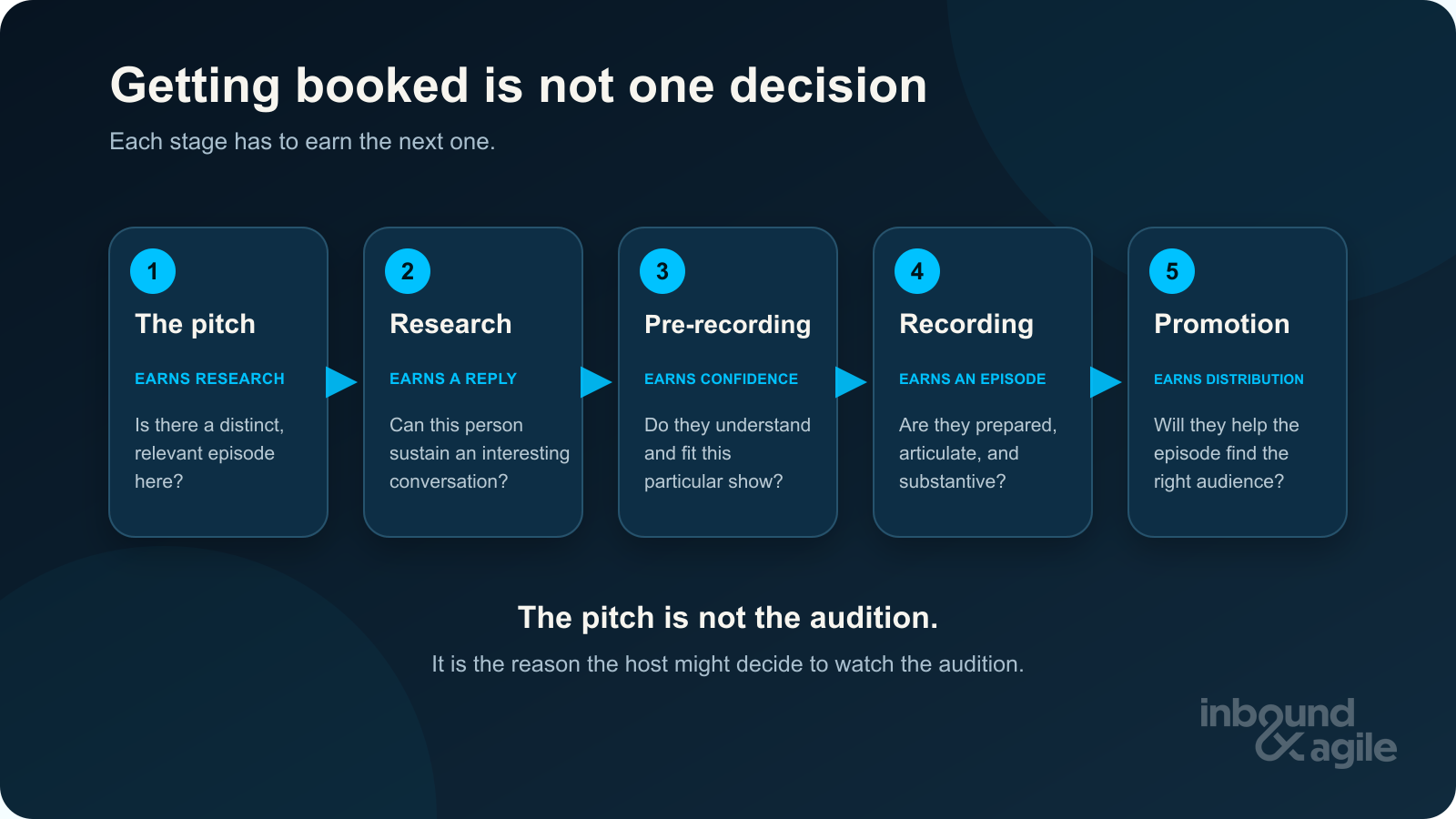
Getting booked is not one decision. The pitch should make the host want to research you. Your work, prior interviews, and public track record should make the host reply. If a cold email earns an immediate yes, you should probably evaluate the show as carefully as it evaluated you.
Research the podcast’s focus and format
“Business podcast” or “leadership podcast” is not enough. Two shows in the same category can want completely different guests.
The Unfolding Thought Podcast is built around long, in-depth conversations. Another show may examine origin stories. Another may want useful tips that can be explained in 20 minutes. Some podcasts move quickly and stay close to the surface by design. None of these formats is inherently better, but the same pitch will not fit all of them.
Before reaching out:
- Start with one strong-fit show, then examine related shows, its guests’ other appearances, and where people in adjacent fields have been interviewed.
- Read the show description and any guest information the host provides.
- Listen to at least one recent episode, not only the trailer.
- Scan the archive for overlapping guests and subjects.
- Notice the typical length, pace, level of detail, and kinds of questions.
- Watch the clips. They often reveal what the producer considers worth pulling from a conversation.
If the host sends you a guest-information page, read it before you continue. I have one for The Unfolding Thought Podcast. I send it to approved prospects so they can decide whether the show is right for them. Ignoring information like that suggests the guest is more interested in being booked than in the conversation being good.
Pitch the chapter, not the book
Imagine trying to cram the whole story of a 200-page novel into a 60-minute recording. You might be able to tell most of the story, but you will not be able to explore it. You will end up stating facts and losing the insight and drama.
Discuss only the chapter where you encountered a real crucible moment, where the two main characters fell in love, or where the bad guy stalked his way through the silent house. Suddenly, there is space to explore. And, you might just leave the listener wanting more.
The same principle applies even if you have never written a book. Your career, research, company, method, and life story are the book. The pitch needs one chapter.
One claim.
One reason you know.
One tension worth exploring.
“I can discuss leadership, culture, innovation, resilience, AI, and high performance” is not an episode. It is a shelf of books.
“Most high performers mistake exhaustion for commitment, and the data they ignore can show the difference” gives a host something to investigate.
How to pitch yourself as a podcast guest
A useful cold pitch can be short. It needs five things:
- A subject line that names the idea, not merely “Podcast Guest.”
- One sentence showing why the idea fits this particular show.
- One focused premise with a real point of view.
- A brief reason you can speak credibly about it.
- One link to a representative interview, talk, article, or other proof.
Then ask whether the conversation would be useful. Do not make the host sort through six possible topics, a full biography, three attachments, and a calendar link before deciding whether there is an episode here.
The two podcast guest pitch examples below show the difference between describing a person and proposing an episode.
A pitch that makes the host do all the work
This is how a typical pitch I receive goes.
This may be polished, but it gives the host no episode to evaluate. “Unique” is asserted. The subjects are broad. The sender has not shown that they understand the show. The host must do all the editorial work.
A pitch that gives the host a conversation to consider
This is also anonymized and condensed from a real pitch.
The second email works because the host can see the episode. The premise is clear, there is something to test, and one link gives the host a way to judge the guest. The email asks for consideration, not a calendar slot.
Follow up on a podcast guest pitch once
If the pitch is a strong fit and you hear nothing, wait about a week and follow up once. Keep it short. Restate the proposed conversation or add something that makes it more timely or easier to evaluate. Do not send a string of “just checking in” messages.
Silence can mean busy, not interested, not now, or not a fit. One useful follow-up gives the host another chance to see the idea. Repeated nudges do not improve the idea.
The exception is when you sent an email rather than a form submission and have reason to think it went to spam. In that case, send one short message through a social channel: “I emailed you about podcasting together. It may have gone to spam, so I wanted to check. No pressure.” That is a nudge to look for the email, not a second pitch. Send it once.
Make it easy to evaluate you
Before replying to a cold pitch, a careful host is likely to search for you. The host is trying to answer one question: Can this person sustain a good episode?
If the host finds past interviews, the questions are simple: Are you clear? Do you answer what was asked? Can you tell a story? Do you have a point of view? Do you rely on filler words? Does the finished conversation sound heavily repaired in editing?
If no interview exists, create some evidence. Record a conversation with someone willing to challenge you or start with smaller shows that fit you well. Speaking at an event can help too. Practice until you can explain the idea without sounding as though you are reciting it.
Fame is not the issue. Uncertainty is. With no public evidence that you can carry a conversation, a cold pitch to a selective show has much farther to travel.
Do not judge a podcast by one public number
Podcast audience data is frustratingly opaque. Apple Podcasts and Spotify provide listening data to the publisher, not to a prospective guest. Completion rates and many host-platform download totals are also private.
For example, The Unfolding Thought Podcast gets most of its listening through Apple Podcasts and Spotify. An outsider cannot verify those numbers. A full episode on YouTube may show only 20 to 100 views, but that public count does not show what percentage of the conversation people watched. Our short clips commonly receive 500 to 5,000 views. They may draw little commentary while still holding a strong percentage of viewers through the full clip.
This screenshot from our YouTube analytics shows views alongside average percentage viewed.
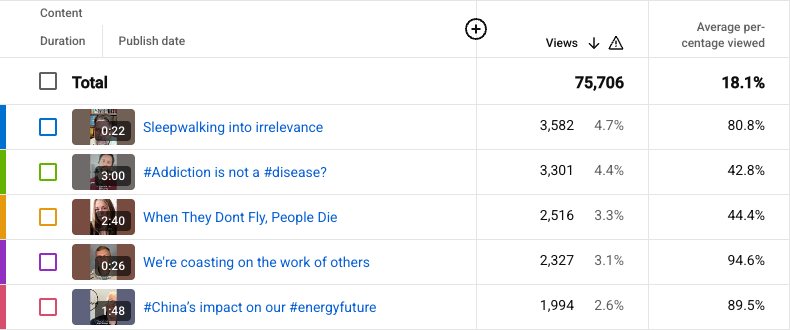
One clip received 3,301 views, but viewers watched 42.8 percent on average. Another received 1,994 views, but viewers watched 89.5 percent on average. That is a massive difference in attention. From outside the channel, you see public subscriber and view counts. You do not see how many subscribers actually watch, or whether the average viewer watched 10 percent or nearly all of a clip. Focus on quality and fit well before you focus on numbers.
Treat public metrics as clues. They are not proof. Review the podcast channels, YouTube, the website, social channels, clips, reviews, consistency, guest quality, and production. Only after you understand the show should visible audience size influence the decision.
Look at the clips, not only the episodes
A show may create more reach for your ideas through clips than through complete episodes. That can be a useful outcome, not a consolation prize.
Our clips deliver a full point rather than merely teasing the episode. A viewer does not need to hear the complete discussion to understand and share one useful idea.
Clips also show whether the podcast treats distribution as part of the work or simply uploads something after recording. Are the clips carefully chosen? Are they titled and captioned well? Do they deliver a complete idea, or do they feel like random excerpts posted to check a box?
If the show invests in distribution, expect it to want the same from you. Share the episode and clips. Participate in the posts around them. Help the strongest ideas travel.
Make sure you can speak in complete, clip-worthy thoughts. You do not have to manufacture controversy. A clear claim or concrete example often gives the editor enough to use.
Bolder claims and predictions can help, but every show draws the line differently. Research it before deciding how hard to push.
Podcast guest pitch checklist
Before you send the email, check the following:
- I can describe the show’s audience in a sentence.
- I listened to a recent episode and examined the format.
- I checked the archive for overlapping guests and topics.
- I am pitching one chapter, not my whole biography or body of work.
- My subject line names the idea.
- The email explains the listener’s reason to care.
- I included one useful example of how I speak.
- I removed claims such as “unique” that the email does not prove.
- I know how I will prepare if the host says yes.
- I have a realistic plan to promote the episode and its clips.
- I logged the pitch, date, follow-up, and outcome so I will not duplicate outreach or lose track.
If several of these are missing, do not polish the email yet. Fix the offer or choose a better show.
Frequently asked questions about becoming a podcast guest
How do I find podcasts that accept guests?
Start with one show that clearly fits and expand outward. Look at related shows. Trace where its guests have appeared, then examine the podcast appearances of people in adjacent fields. Use Apple Podcasts, Spotify, YouTube, podcast directories, and guest platforms to broaden the list. Before pitching, confirm that the show still publishes and interviews guests. Make sure it covers ideas you can address specifically.
How big should a podcast be before I agree to appear?
There is no defensible universal threshold. First evaluate the fit and the likely value of the conversation. Then look at production, consistency, distribution, and clips. Use visible audience size only as a tiebreaker.
Do I need previous podcast appearances?
No, but evidence helps. A strong cold pitch is easier to accept when the host can hear how you think and speak. If you are unproven, build that evidence on smaller, relevant shows or through a recorded interview, talk, or discussion of your own.
How long should a podcast guest pitch be?
Long enough to show fit, premise, authority, and proof. In many cases, 100 to 175 words is enough. A complex idea may need more, but length should come from useful specificity, not biography.
What makes someone a good podcast guest?
A good guest brings a relevant idea and explains it clearly. They support it with experience or evidence and respond to the host instead of reciting. They also help the finished episode reach the people it can serve.
The point is not to get booked
Every appearance takes your time. It also takes the host’s preparation and the production team’s work, then asks an audience to give up part of its day.
A worthwhile pitch accounts for that before it is sent.
Find a show where one focused part of what you know belongs. Give the host enough to see the episode, enough evidence to research you, and a reason to believe you will help the finished work travel.
A yes from the wrong show is not a win. The useful outcome is an episode that should exist.