

My contribution to German intellectual history was going to involve vegetables.
During my first master’s degree, in Germanics, I became interested in the vegetarianism and the back-to-nature thinking of certain German writers and philosophers around the end of the nineteenth century. I wanted to investigate how these interests fit together. After explaining this to a professor though, he gave me a quick and sharp verbal slap:
“You’re getting a German degree, not a food science degree.”
He may have been right. When I told this story to the psychologist Adam Mastroianni on The Unfolding Thought Podcast, I said I probably would have written a terrible paper. I still have no grounds for promoting it to a lost masterpiece. Please do not organize a conference on my behalf. The catering would be difficult.

I wrote about something else.
The paper I wrote could be evaluated. The paper I did not write could not. My professor helped decide which of those outcomes anyone would get to see. We cannot tell whether he spared me a bad paper or stopped me from writing a worthwhile one.
A funded project can embarrass the person who funded it. A rejected project often cannot. The rejection can prevent us from collecting the evidence that would show it was a mistake.
The point is this: the rejected project might have been worthwhile. My unwritten essay might have been great. The girl you never asked out might have said yes. We don’t know, because we stopped the process before it could give us an answer.
Not getting an answer is different from being right.
That does not make the rejection wrong. We have to choose without knowing everything, and some possibilities deserve more of our time than others. But making a reasonable choice is different from proving that our way of choosing works. If we keep judging it only by the projects it allows us to see, how would we discover its mistakes?

Forthcoming March 23, 2027
Adam’s publisher describes his forthcoming book, The Strangest Idea in the World, as an exploration of the psychological obstacles to discovery. In our conversation, he described the difficulty of noticing what we do not understand, questioning whether anyone else understands it, and pursuing answers that may initially sound ridiculous.
An organization can make its own judgment much harder to test. The people who decide which work deserves support may also decide whether anyone gets to investigate how well they choose.
Suppose an employee proposes funding a few projects her department’s standards would typically reject. The managers that she needs to approve the funding might reject the project using the very assumptions her experiment is meant to test.
For the sake of illustration, imagine a parent that is wrong about something and a child asking them to just consider some details that would show that the parent is in fact wrong. But rather than dealing with the proposed test, the parent simply responds, “I’m the parent. Listen to me.” How could the test here possibly prove anything when the decision making authority relies upon the flawed premise that needs to be tested?
Back to work, those managers need not be dishonest. They may sincerely believe the rules protect everyone’s time. But the experiment could show that some of their work is unnecessary or their budget would do more good elsewhere. The people who stand to lose authority are being asked to pay for the evidence.
Adam argues that scientific models should be specific enough to build on and overturn. I want to apply that demand to the institution doing the investigating. Who can fund a test of its judgment, and who can act if the evidence goes against it?
A perfectly functional ignorance
We get through most of the day without understanding very much of it.
Using something successfully can give us an exaggerated sense of understanding it. In their research on the illusion of explanatory depth, Leonid Rozenblit and Frank Keil asked people to rate their understanding of familiar mechanisms, explain them, then rate their understanding again. Trying to explain often exposed how little they understood.
In a talk I give on culture change, I use an example from a 2006 study by psychologist Rebecca Lawson. She gave participants diagrams with the wheels, seat, and handlebars already in place and asked them to add the frame, pedals, and chain. A bicycle is familiar enough that this can sound almost insulting. Two wheels. A seat. Handlebars. How hard could it be?
The drawings below, reproduced in Scott H. Young’s explanation of the illusion, show some of the results. The bicycles are recognizable. Getting anywhere on them would be another matter.
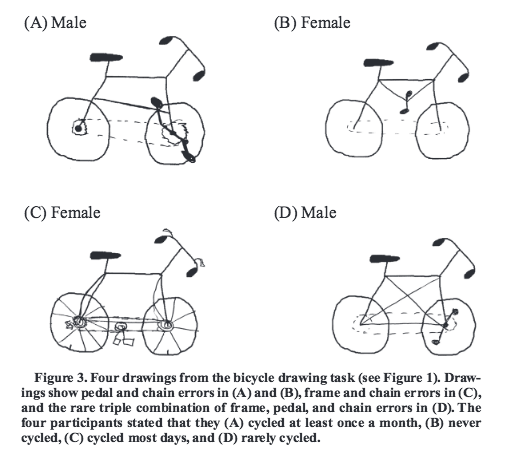
The point I make in that talk is that people often assume that because they know something works, they know why it works. But that is rarely the case. They know it works. That’s where their understanding stops.
Adam used the toilet as an example in our conversation. Most of us know what to do with one. Explaining its mechanism in enough detail to build it is another matter.
Yet the toilet works. Why interrupt a successful relationship?

I wanted to know what gets us from thinking we have an explanation to recognizing that we need one. A working toilet gives us little reason to investigate. Neither does a hiring process that produces good employees—unless we ask whether the process deserves the credit.
How do you know your judgment helped?
Adam has made the selection problem explicit. In “Against All Applications”, he imagines an employer pleased that 75 percent of its hires are good hires. What if 75 percent of the original applicant pool would have been good hires anyway? The hiring process could be expensive and elaborate while contributing nothing. He proposes testing it by hiring randomly and comparing the results with the selections the employer would otherwise have made.
Extreme and unrealistic? Yes. But, you get how this would actually show if your hiring process actually improves anything, right?
Bob Hoffman gave me a useful way to see the difference between actions that actually improve outcomes and actions that just happen to accompany them when he joined me on The Unfolding Thought Podcast.
If you run a pizza shop and want to juice business, you might run a promotion with discount coupons. The coupons being redeemed at a high rate would probably tell you if your promotion was successful, right? So, where would you distribute the coupons in order to get the highest redemption rate? You’d distribute them to people already in line at the pizza shop.
The redemptions are real. What they cannot tell you is how many purchases the coupons caused. You chose people who were already there, so your impressive result never had to answer the question the owner actually cared about: did the promotion bring in business?

Back to hiring, if your hiring process results in 3 out of every 4 hires being successful, how do you know that 3 out of every 4 wouldn’t have been successful if you’d just hired randomly? You don’t unless you test it. But, the people deciding what tests are worth approving disapprove of this test on the grounds that their hiring process is so obviously positive.
The future comes with your fingerprints on it
Support changes what happens next, and therefore what future evaluators get to see.
Imagine two teams asked to investigate different approaches to a problem. One receives experienced staff, repeated attempts, and a patient sponsor. The other receives a junior employee on Fridays. Eventually the first approach works better. That difference is real. What does it prove about the original choice?
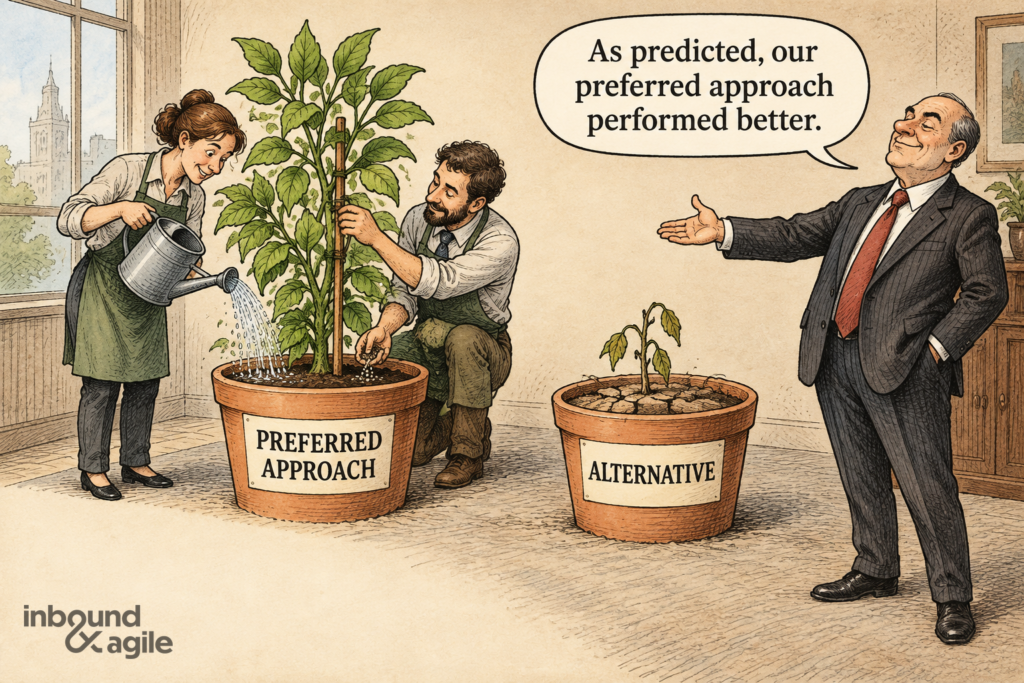
If the organization forgets what it supplied to each team, the difference can look like a discovery about the approaches themselves. The annual report records which one worked. The junior employee’s Fridays disappear from the explanation.
Funding decisions can also change who gets another chance. In a Dutch study discussed in Adam’s essay on grants, Thijs Bol, Mathijs de Vaan, and Arnout van de Rijt compared applicants just above and below an early-career funding threshold. Over eight years, near-winners received more than twice as much subsequent grant money. Their publication and citation records showed no corresponding jump. And, winning made them more likely to apply for the next funding opportunity.
A replication across fourteen programs and six funders also found an advantage of earlier funding for later funding. Much of it reflected who reapplied. Its results also challenged the comforting interpretation that rejection makes the surviving researchers stronger.
This is a particularly nasty twist. An institution can help people advance, then congratulate itself for having identified their promise. It can also discourage people, observe the exceptional ones who return, and congratulate itself for having strengthened their character.
Everybody gets a moral. Some people do not get a career.
Who gets to choose the next question?
In our conversation, Adam described one of his studies on when people want conversations to end. The research asked participants afterward about their experience. I wanted to know whether those answers reflected what they had felt in the moment or the story they assembled later.
He had worried about this too. At one point, he ordered foot-operated buttons so participants could privately signal to the researchers the moment they wanted out of the conversation.
Lo and behold, the buttons clicked. Loudly.
This is an unfortunate feature in a device whose purpose is to silently communicate “I would like to stop talking to this person” without communicating it to that person.

Big surprise, they did not end up using the buttons. Adam explained that they instead focused on the account people took away afterward, which mattered for how they would approach later conversations. That is a question worth studying. It just does not tell us exactly what someone wanted at each moment of the exchange.
Adam could explain why he chose that question. Now consider what happens when researchers have a reason to ask a different one, but their organization will only pay for the original.
Imagine a team testing instructions for assembling an object. It randomly assigns people to hear Script A or Script B and counts the steps they complete correctly. To keep the comparison controlled, listeners cannot ask questions.
Now suppose a participant breaks the rule and asks, “When you say left, whose left?” The instructor answers, and the task proceeds easily.
The extra help means this result cannot show that one script was superior. But it suggests another question: would people do better if the instructions allowed for clarification?
Suppose the team works for a department whose job is to produce scripts. Its director will fund another script comparison, but considers questions a sign that the instructions need more work. He may be quite sincere. Writing better instructions is his job.
The team records the interruption correctly and returns to testing scripts. The organization can keep learning which script works best without testing the rule that makes everyone listen without asking questions.
Chris Argyris called learning that questions an organization’s underlying rules and objectives double-loop learning. Here, the people best placed to notice the limitation have no power to investigate it, and the person with the power sees it as somebody else’s responsibility.
This was what Adam noticed in my Germanics story. The organization of a university is not a description of how reality has divided itself. Departments develop expertise, but their boundaries do not accurately describe the real world.
Permission to disappoint the person paying
Being more open-minded about what kinds of experiments you approve sounds like a solution until we ask who pays for being wrong.
In Adam’s strong-link argument, a few exceptional discoveries can outweigh many unproductive attempts. But what an institution can afford across its portfolio may be disastrous for a person’s reputation that is tied to the attempt.
A company can fund ten uncertain projects and be delighted when one succeeds. Nine people can still learn that they should have chosen something easier to defend if they are not adequately protected from a test failure. Or the scientist who discovers the flaw in a prestigious program can do work of enormous value while becoming the person nobody wants on the next program.
The organization can afford for an idea to die. The person attached to it may not be able to afford to deliver the news.
Celebrating failure alone will not fix these issues for the individual driving an attempt at discovery.
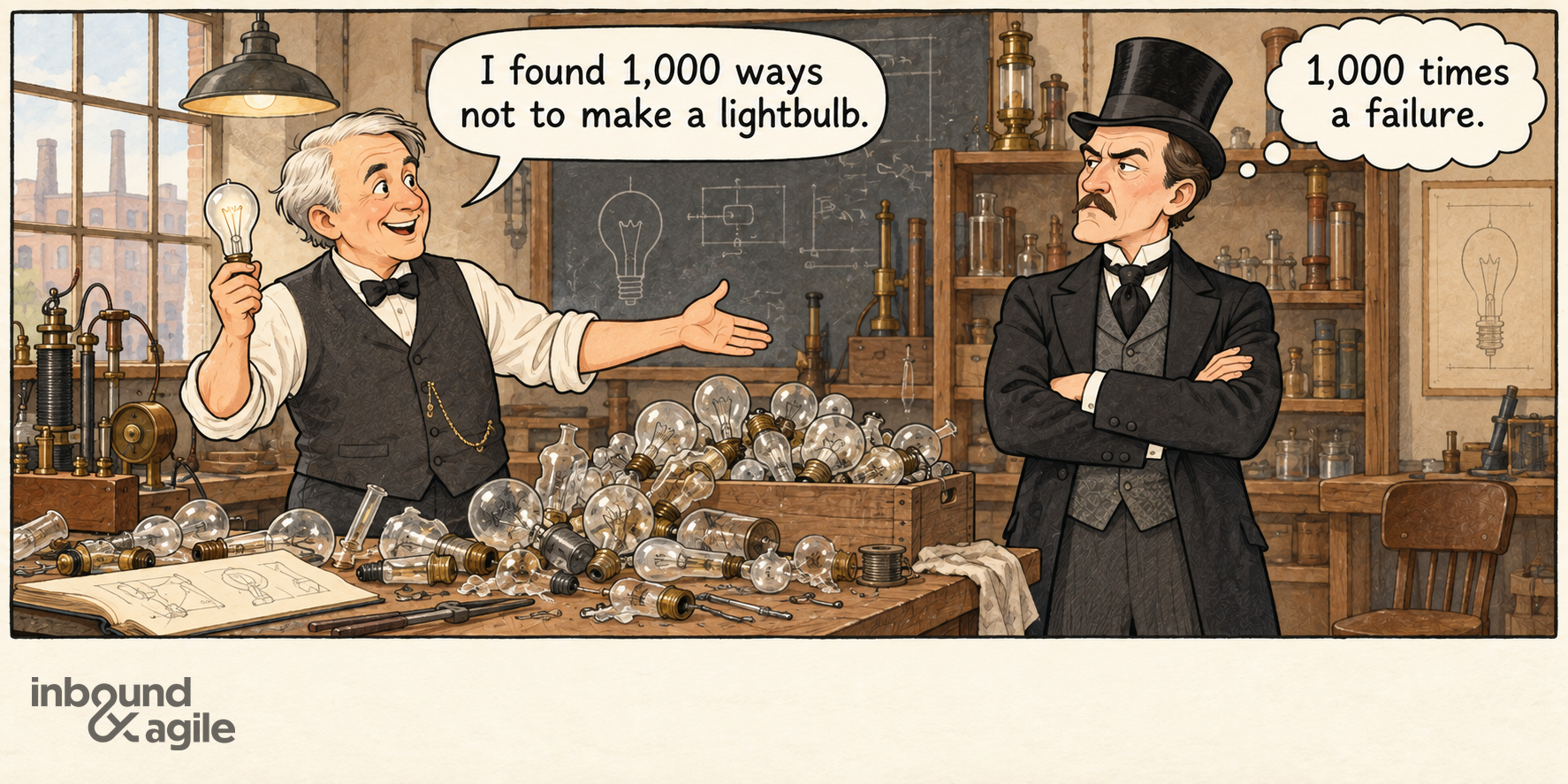
The sponsor has obligations too. If you authorized an investigation under acknowledged uncertainty, you cannot fairly behave afterward as though you commissioned certainty and received a defective shipment.
Oh my goodness, could I tell you stories and stories and stories about being told to run an experiment, only to have it dismissed as a complete waste of time when the results came in. Few things in my career have infuriated me more than the intellectual dishonesty of approving a test and then calling it pointless because the new version didn’t beat the control…or because the test beat the control, which, you know, we totally should have predicted and therefore it shouldn’t have been an experiment at all.
You can ask whether the work was competent, whether its conclusions follow, and whether another attempt would be worth making. You should. You also have to retain your own name in the history of why the question was worth asking.
The person paying for discovery is buying the possibility of an answer they would not have chosen.
If every acceptable answer must leave the sponsor’s judgment, budget, and self-description intact, what exactly are we being paid to investigate?
The loophole cannot become the whole building
There is a wonderfully convenient abuse of everything I have just argued: whenever your work disappoints, announce that the organization is using the wrong definition of success.
This is why the ability to change a question has to coexist with a durable record of the question you actually asked. New understanding does not authorize editing the past.
If the original hypothesis failed, it failed. If the experiment was inconclusive, it was inconclusive. If you did not carry out the experiment competently, the fact that the experience inspired another idea does not erase that failure. A better question may be a valuable result of the work, but its value requires an argument of its own.
The interruption in the assembly experiment is a reason to test clarification, not evidence that one script won. A new question earns its place through a specific observation and an account of what we could learn next.
Unconventionality offers no exemption from this problem. A charismatic founder can dismiss criticism more efficiently than a committee. A private patron can favor familiar people while describing the preference as taste. An independent lab can become a place where everyone is free to disagree with the founder in ways the founder finds exciting.
Adam’s Science House prototype deserves attention because trying a different arrangement can teach us something that defending the familiar one cannot. The alternative must remain open to the same scrutiny. Being smaller, stranger, or outside an institution is a reason to investigate what it enables, not proof that it works.
A good process does not abolish judgment. It gives judgment somewhere to encounter its limitations.
A discovery institution should be overturnable too
I asked Adam about constraints. You cannot support everything. You have to choose. My suggestion is to start with a rule that makes consequential decisions repeatedly, rests on uncertain evidence, and could be tested at a manageable cost. The organization need not reopen every rejection to investigate whether one of its rules deserves the authority it has.
There is a limit to what another procedure can do. In “Shame them, shun them, ban them, beat them!”, Adam argues that rules cannot make people care about finding the truth. People can ignore evidence as readily as a requirement to consider it. Another committee may just be another committee to disappoint.
But caring is not enough if the evidence never gets produced. A script director willing to change his mind may never encounter a reason to do so if every study must begin by accepting his rule against questions.
Suppose the head of training can fund a small follow-up without that director’s approval. The researchers randomly assign people to receive the same instructions, with one difference: some can ask for clarification. They record errors and the total time involved, including time spent answering questions. Fixed instructions might work better. Or questions might prevent enough mistakes to justify the extra time. The result could also be inconclusive.
Before the test begins, the head of training agrees to review the rule when the results arrive. She has authority to change it and a budget to try the change in practice. If the evidence favors allowing questions, the script director can dispute it, but his objection does not automatically end the discussion. His department could keep writing instructions while losing its veto over clarification.
Now the experiment can change a decision. If an outside institution funds the study and uses the findings while the original one refuses, that may be valuable too. But we should credit the institution that changed, rather than congratulate the other for having tolerated dissent. Making room for alternatives and learning from them are separate accomplishments.
This will still require people willing to reconsider. The head of training can be wrong too. The arrangement gives evidence a route to a consequential decision; it cannot guarantee the decision will be wise. And some commitments are values rather than empirical claims. A university can value a particular education without claiming it maximizes earnings. But if a process claims to select better people or make better work possible, that claim should be open to testing.
Otherwise, every applicant must demonstrate merit while the method used to judge merit need only demonstrate longevity.
Correction need not mean permanent upheaval. If the test favors clarification, the script department can keep writing instructions while giving up its rule against questions. Its expertise remains useful even when one of its decisions needs to change.
An institution that helps discover a better way to do its work has contributed something even if the better way makes part of the institution unnecessary. Recognizing that contribution is more demanding than praising innovation. It asks people with authority to support a future in which their present authority may matter less.
The paper is still unwritten
My professor may have understood a limitation in my preparation that I had not yet learned to recognize. Casting him as the villain would give me a flattering part while dodging the uncertainty that makes the story interesting.
What I would want to preserve is the distinction between this is not the right project for you now and there is nothing here. The first can be excellent guidance. The second is a claim about the world that requires more evidence than a departmental boundary provides.
I might have written a terrible paper about Germans and vegetables.
The unwritten paper cannot testify for either of us.

This essay grew out of my conversation with Adam Mastroianni for The Unfolding Thought Podcast. You can read Adam’s work at Experimental History.
Sources and further reading
- Adam Mastroianni, “Against All Applications”; essays on grant funding, strong-link science, scientific models, Science House, and the limits of rules.
- Leonid Rozenblit and Frank Keil, research on the illusion of explanatory depth; Rebecca Lawson, the bicycle study (2006).
- Thijs Bol, Mathijs de Vaan, and Arnout van de Rijt, early funding and later grant success (2018); the cross-funder replication (reviewed preprint).
- Bob Hoffman, conversation on The Unfolding Thought Podcast, including the pizza-coupon example.
- Chris Argyris, “Double Loop Learning in Organizations” (1977).