Geoffrey Moore built one of business’s most durable ideas by noticing what a familiar chart left out.
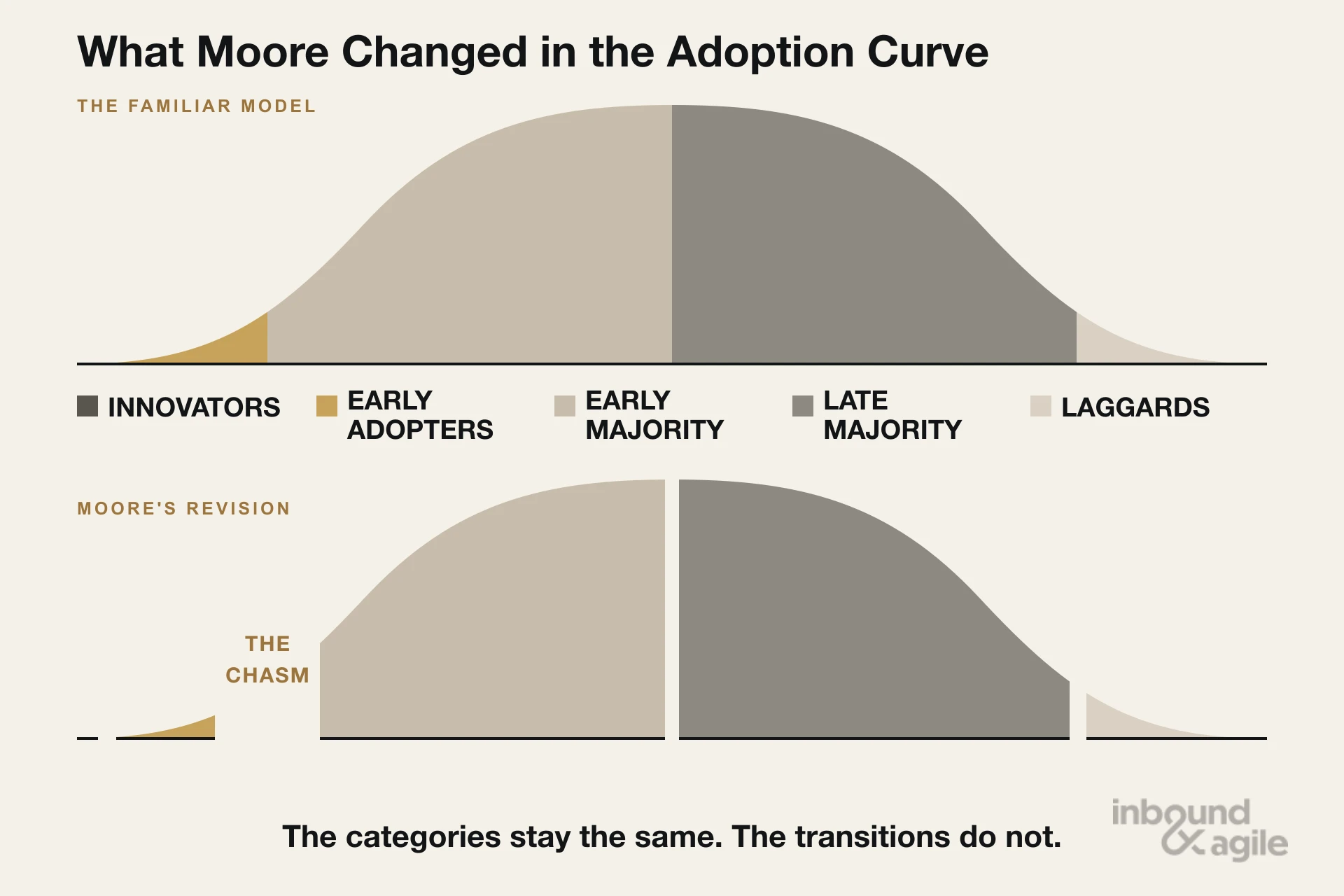
The Technology Adoption Life Cycle drew its categories from Everett Rogers’s research on the diffusion of innovations. Innovators tried a new technology first. Early adopters followed them, then the early majority, late majority, and laggards. High-tech marketers turned those categories into a smooth market-development story: win over one group, use it as a reference for the next, and keep moving from left to right.
Moore says that story was abstracted largely from flagship successes. He and other Silicon Valley operators had also lived through ventures that disappeared or left their shares worthless. Those failures did not look like a smooth market-development story. When Moore recast the curve, he drew gaps between the groups and made one much larger than the others.
That gap became the chasm.
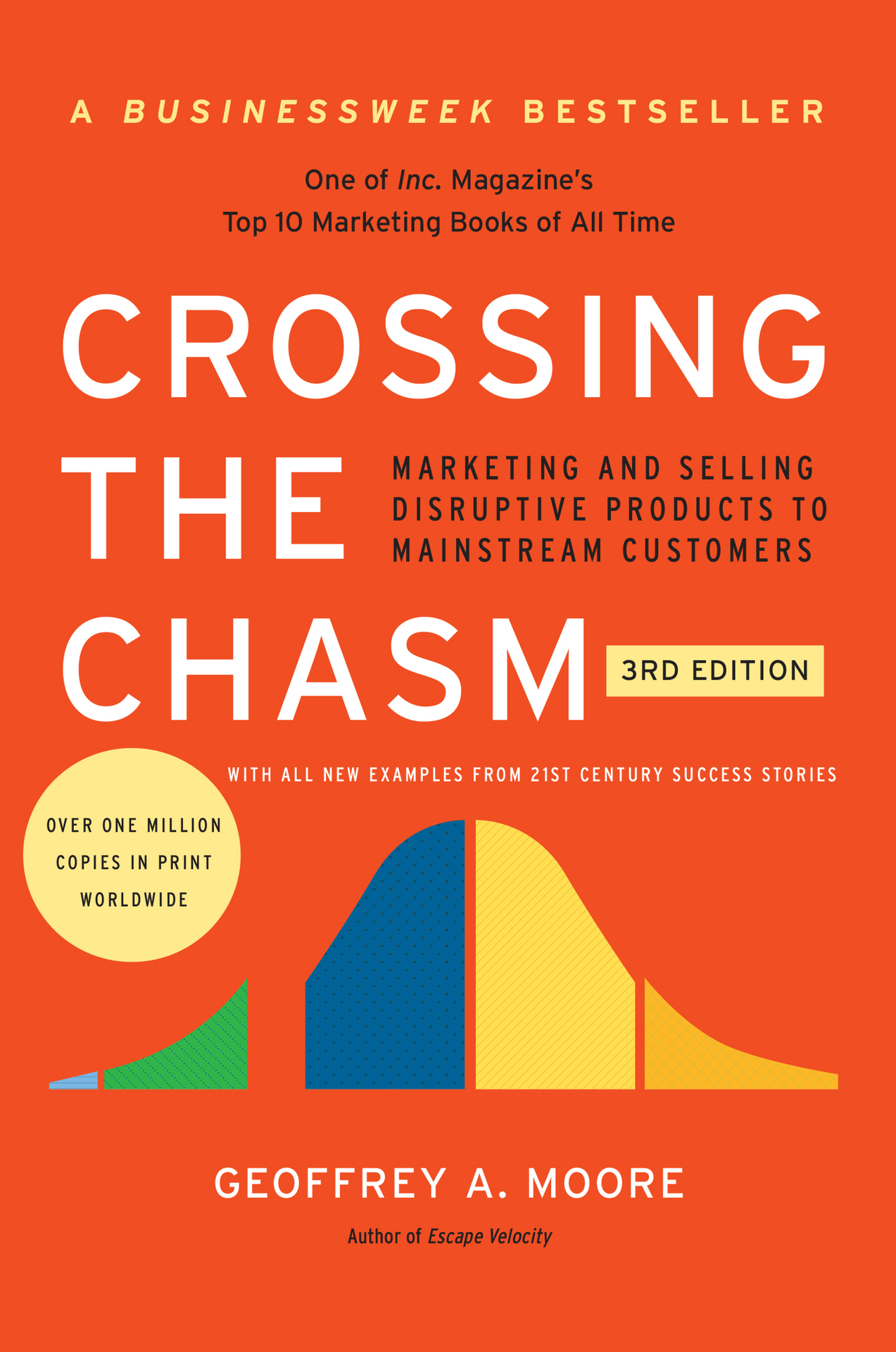
The familiar framework in Crossing the Chasm did not begin with Moore defending a model. It began with him deciding that an accepted model had become too elegant to describe what companies were actually experiencing.
After my conversation with Geoffrey Moore for The Unfolding Thought Podcast, I kept returning to the same thing: he built the chasm by distrusting a framework that looked more orderly than the world it was supposed to explain. We talked about chasms, tornados, and staircases. But the larger question is what happens when people stop treating those images as aids to thought and begin treating them as reality.
The chasm exists as an idea because Geoffrey Moore was willing to break a framework that no longer fit the evidence.
Moore calls these root metaphors, borrowing and broadening an idea from Stephen C. Pepper’s World Hypotheses. Pepper used root metaphors to describe the organizing images beneath entire systems of thought. Moore applies the idea more practically to frameworks such as the chasm, the tornado, and the staircase. The point is not literary. A metaphor gives people a shared picture of a complicated situation, directs attention, and helps them act before they have an ironclad case. It makes some relationships obvious, some actions sensible, and other possibilities harder to see.
This is the old distinction between the map and the territory. The map is useful precisely because it leaves most of the territory out. It gives us something small enough to carry, share, and use. But the thing that makes it useful is also what makes it dangerous. If we forget what was left out, we start treating lines someone drew on a map as if they were features of the landscape itself.
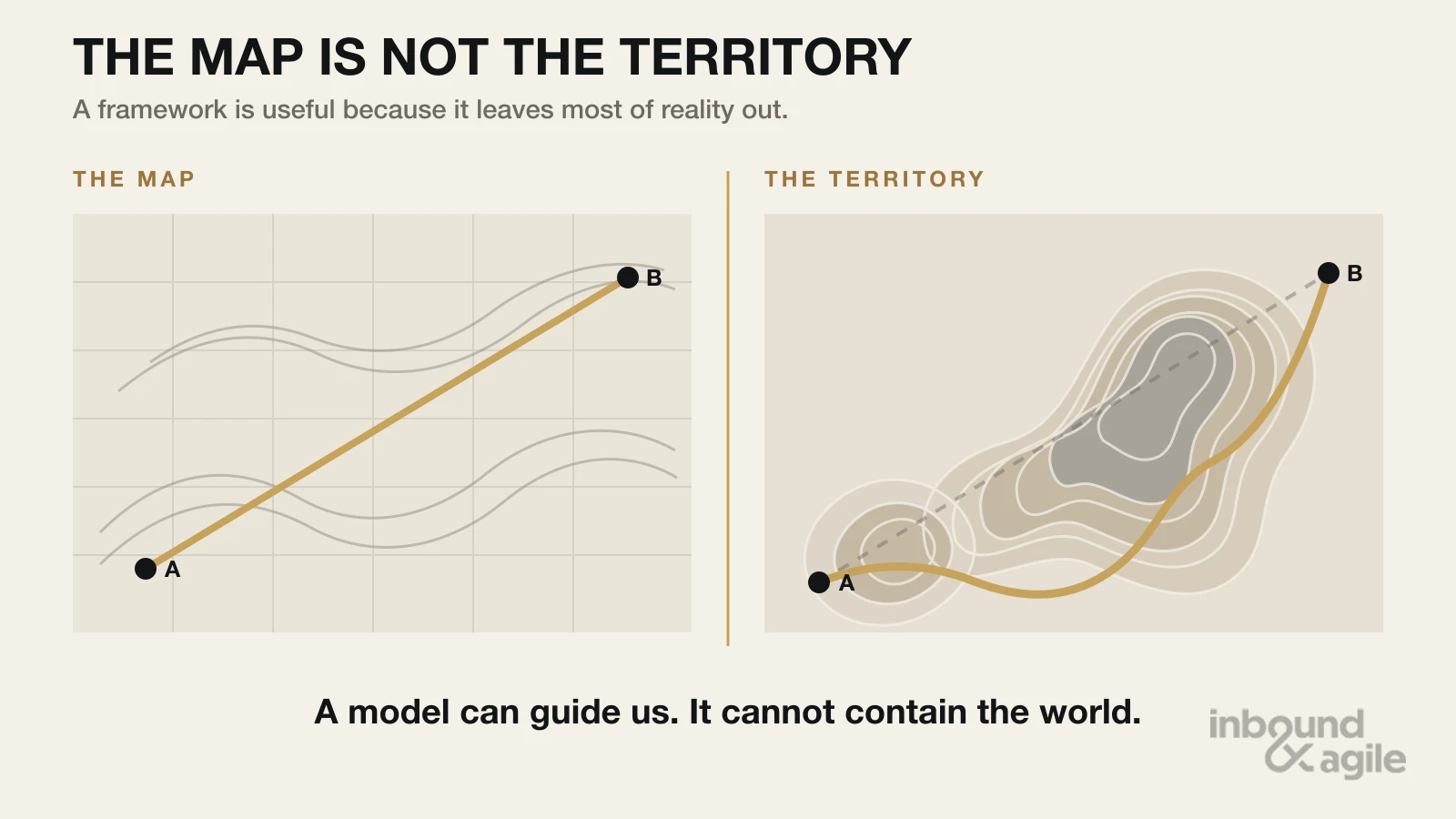
Not every framework puts its metaphor in the title, but every framework simplifies. I am using framework broadly here. A metaphor, a model, and a dominant logic are not the same thing. What they share is that each selects which relationships matter, which facts deserve attention, and which actions seem reasonable.
Eventually, people stop saying, “This situation resembles a chasm.” They say, “We are in the chasm.” The comparison has become geography.
That is when a framework can become the problem, especially after its assumptions have been built into the budgets, metrics, roles, and routines through which the organization operates.
We cannot lead without simplifying
Management frameworks are reductive. That is their purpose.
No leader can absorb every relevant fact, understand every relationship, anticipate every response, and calculate every possible result before making a decision. Herbert Simon’s work on bounded rationality begins with this constraint. Karl Weick, Kathleen Sutcliffe, and David Obstfeld describe sensemaking as turning unclear circumstances into a situation we can understand in words and use as a springboard into action. We simplify because we have to. A good framework makes the simplification usable.
In an author’s note in Crossing the Chasm, Moore writes that experienced technology executives often told him the book had not really taught them anything they did not already know. It had gathered their “scattered intuitions and rueful learnings” into a coherent framework. They passed the book to colleagues partly to spread the vocabulary. Some companies made it required reading simply so everyone could discuss the market from a shared starting point.
That is an enormous organizational advantage. Before the framework, six people may be carrying six partial understandings that take an hour to explain and still do not quite connect. After the framework, one person can say “the chasm,” and the group can retrieve an entire pattern of customers, risks, and strategic choices. The word compresses experience.
Moore called this “metaphor-market fit” in our conversation. The metaphor feels intuitive enough that people can use it without stopping to reconstruct the argument every time.
This becomes especially valuable when a company faces something new. In Crossing the Chasm, Moore describes the choice of a first mainstream market as a “high-risk, low-data” decision. The company must make a consequential commitment with little useful hard information and no direct experience from which to predict what will happen.
Waiting for certainty can paralyze a company. Pretending certainty exists gives it false confidence. A framework gives people a provisional way to act, investigate their assumptions, and revise the description as reality supplies information.
AI is forcing leaders to choose a metaphor
The evidence is incomplete, the capabilities are changing, and businesses still have to make decisions. So leaders reach for a comparison.
Calling AI a tool leads toward training people to use it. Calling it a coworker leads toward questions about roles, supervision, and responsibility. Calling it an employee leads quickly toward headcount and replacement. Calling it infrastructure suggests that the company itself needs to be redesigned around it.
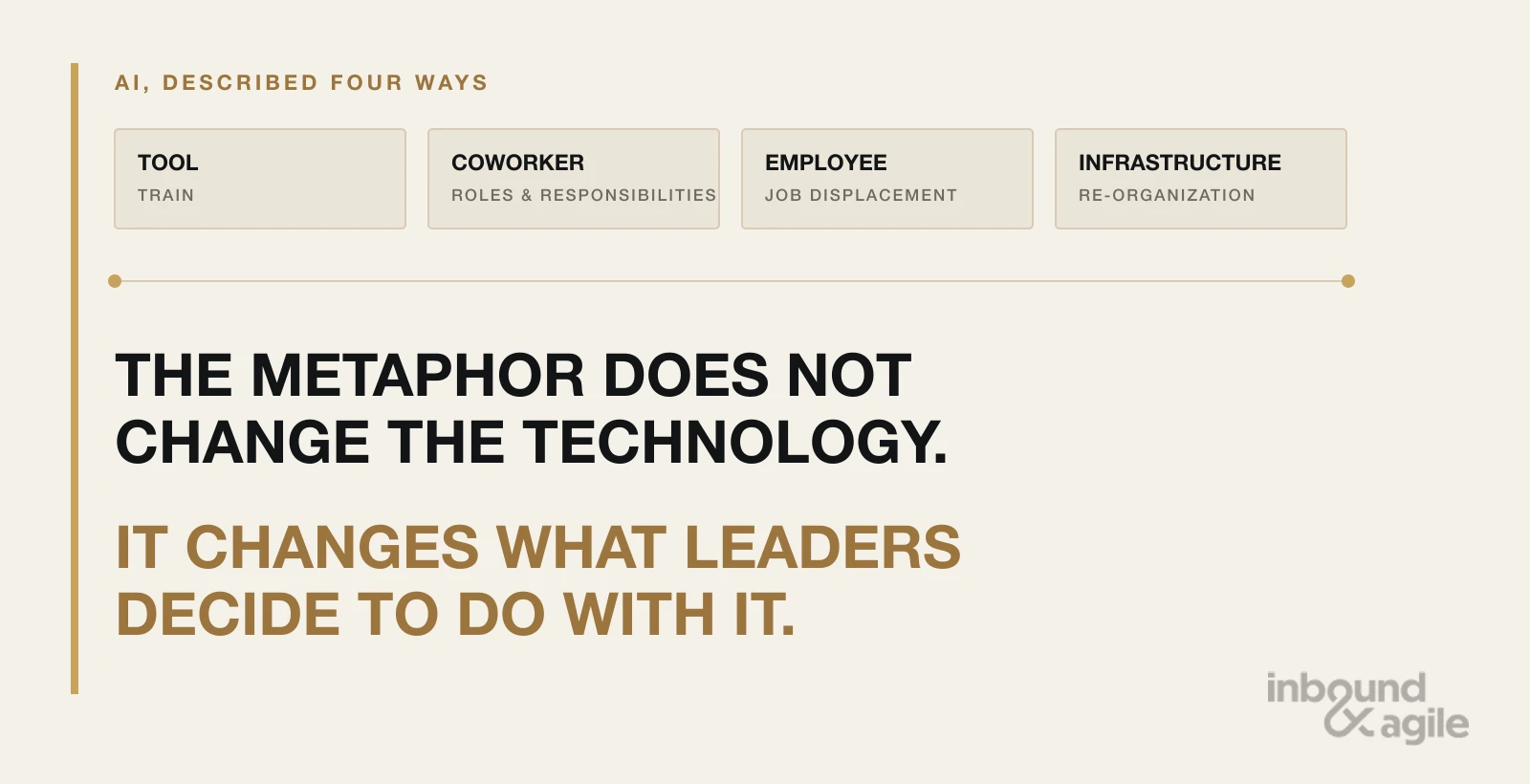
All four comparisons can be useful. The problem begins when a company chooses one, builds the budget and operating plan around it, and then treats evidence that does not fit as resistance or confusion rather than a reason to revisit the original description.
We need the map. We also need to remember that we drew it.
The description has already started prescribing
Moore told me that strategy first describes a situation and then prescribes what to do. If the description is wrong, a coherent and competently executed strategy can make the wrong prescription look rational.
I think this happens more often than leaders admit. Teams can spend hours debating tactics without noticing that the metaphor supplied a questionable account of the problem before the meeting even began.
Consider the language of Crossing the Chasm. A chasm is dangerous terrain. You have to get across it. Moore adds a D-Day metaphor, a beachhead, concentrated force, invasion, and adjacent territory. Once that description is accepted, many of the prescriptions begin to feel self-evident. Pick one narrow market. Concentrate resources. Establish a defensible position. Expand from there.
Change the metaphor, and different actions begin to look reasonable.
One metaphor is not always better than another. Each draws attention to a different part of the situation and leaves another part harder to see. The cognitive scientist Dedre Gentner’s structure-mapping theory helps explain why. An analogy transfers relationships from something familiar into something less familiar. The metaphor brings a pattern of inference with it. Once the market is a chasm, the logic of crossing comes too.
The metaphor does not stay inside one person’s head. William Ocasio’s attention-based view of the firm argues that what decision-makers do depends on which issues and possible answers receive their attention. The company directs that attention through its rules, resources, relationships, and procedures.
Once a framework is built into planning templates, budgets, and meeting agendas, it has become part of the organization’s attention system. It helps determine which facts are easy to see, which questions sound intelligent, and which possibilities never make it into the room.
A framework has no agency of its own. The danger comes when people encode its assumptions in budgets, metrics, roles, and decision routines. At that point, challenging the framework also means challenging the organization built around it.
I see this in marketing. We draw a funnel to describe one possible path toward a purchase, then build the reporting system around it. Before long, behavior the funnel cannot explain gets treated as a tracking problem, rather than evidence that customers were not actually moving through the world in the shape of our diagram. By then, questioning the framework also means questioning the system built around it.
THE FRAMEWORK SERVES REALITY
Contradictory evidence causes the description to change.
REALITY SERVES THE FRAMEWORK
Contradictory evidence is filtered, renamed, or dismissed.
A framework becomes a problem when it starts protecting itself from the world it was built to explain.
Every metaphor has a boundary
Moore said something during our conversation that I think matters more than it gets credit for:
All metaphors have an efficient frontier.
Within some boundary, a metaphor clarifies more than it distorts. Its efficient frontier is the point at which that balance reverses. Past it, the same metaphor begins creating more confusion than insight.
Moore is unusually direct about the limits of his best-known model. Chasm crossing is a particular transition in the adoption life cycle, not a permanent operating method. Microsoft did not follow his niche strategy, and its inherited market position made it a terrible precedent for the ordinary challenger. The book is also explicit that crossing the chasm is a B2B model.
Digital consumer services often spread differently. Rather than forcing them into the chasm model, the book adds a separate Four Gears framework for acquisition, engagement, monetization, and enlistment. Moore marked the boundary and built another tool instead of asking a famous model to explain a market it could not.
Organizations have good reasons to ignore those boundaries. A successful framework gives them vocabulary and confidence. People know it, leaders know how to present it, and teams know how to operate within it. The more familiar the model becomes, the harder it is to revisit when conditions change.
When a framework is right at the wrong level
A framework can fail in at least two ways. It can be stretched beyond the conditions it was built to explain. It can also be used to answer a question that exists at a different level.

Moore develops the second problem through the staircase metaphor in The Infinite Staircase. Physics, chemistry, and biology occupy the lower stairs. Desire, consciousness, values, and culture emerge above them. Language, narrative, analytics, and theory appear higher still.
The precise number of stairs is not Moore’s point. He told me he could have chosen ten or twelve rather than eleven. Higher does not mean better or more important. It means that each level depends on the levels below without being reducible to them. An explanation that works on one stair does not automatically explain another.
Businesses make this mistake when they use language and theory to manufacture something that exists through shared experience. A company writes a values statement and assumes it has created values. It publishes a culture deck and assumes it has created a culture. It teaches a leadership framework and assumes it has created judgment.
Language alone can name, examine, and reinforce what people experience together. Employees learn what an organization values from what leaders notice, reward, tolerate, and do when the stated values become expensive. A statement can remain perfectly coherent while the culture teaches the opposite lesson every day.
A workshop on collaboration will not overcome a compensation system that rewards individual wins. Saying people come first will not rebuild trust after employees watch leaders treat them as expendable. Those are not communication problems. They are evidence that the framework and the lived reality do not match.
Polaroid could build the future but could not recognize the business
The most common story about failed innovation is that leaders could not see the new technology coming. Polaroid is a more interesting case because it could see digital imaging very clearly.
Mary Tripsas and Giovanni Gavetti’s historical study of Polaroid’s response to digital photography drew on company archives and interviews. Polaroid invested in digital technology early. By 1989, it had leading work in image sensors and lossless compression. It had a functioning high-resolution digital camera prototype by 1992.
Polaroid had leading-edge digital-imaging research capability. It failed to develop several of the manufacturing, product-development, marketing, and distribution capabilities needed to turn that research into the right business.
Polaroid’s success had been built on the economics of instant photography. The company could sell cameras relatively cheaply and earn recurring revenue from film. Its leaders understood imaging through that relationship between hardware and consumables. A standalone digital camera that did not create continuing film sales looked unattractive inside the model that had made Polaroid successful.
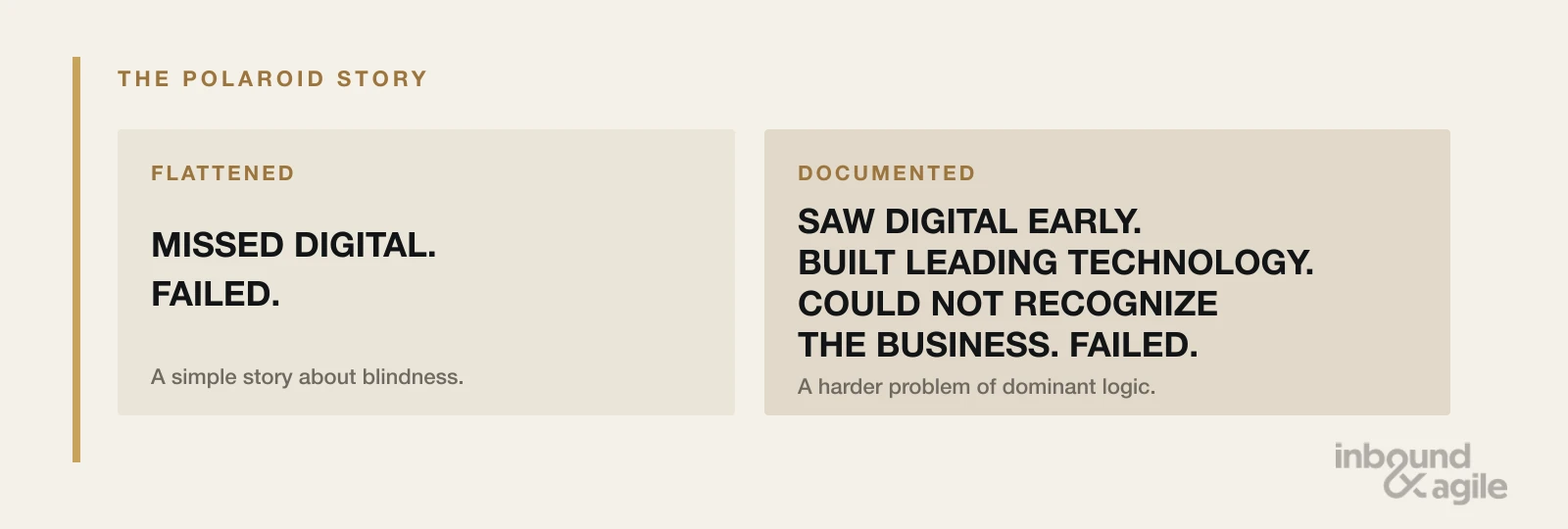
Management kept interpreting digital products through analog economics. It favored products that preserved a printing or consumables component while the company underinvested in low-cost electronics manufacturing, rapid product development, and new distribution channels. Despite having a working prototype in 1992, Polaroid did not announce its PDC-2000 megapixel camera until 1996, by which point more than 40 other firms were already selling digital cameras.
That created a reinforcing loop. The old business model directed investment away from the capabilities a standalone digital business required. The absence of those capabilities then made the new business look even less viable from inside Polaroid. The framework shaped the company’s capabilities, and the missing capabilities appeared to confirm the framework.
C.K. Prahalad and Richard Bettis called this kind of governing worldview a dominant logic. Experience in a successful core business creates mental maps for allocating resources. Over time, the company’s planning, compensation, staffing, and structure can reinforce them. Decades of success had given Polaroid’s framework evidence, believers, vocabulary, and an organization designed to make it true again.
The most dangerous framework may be the one that once explained the business brilliantly.
Even our cautionary stories become frameworks
Even the Kodak story we use to warn against old frameworks has been flattened into one. Kodak did not simply invent digital photography and ignore it. Natalya Vinokurova and Rahul Kapoor’s archival study of Kodak’s attempts at strategic renewal documents decades of investment in digital imaging and other attempts at renewal. Kodak led the United States digital-camera market in 2004 and 2005.
It still failed, but the management problem was more complicated than blindness. Kodak had to find a viable path from an extraordinarily profitable legacy business into a market with uncertain timing and worse economics.
“Do not be Kodak” teaches leaders to look for denial. It may leave them unprepared for the harder case: a company can see the disruption, invest heavily, and still fail to find a new business capable of sustaining the enterprise. Seeing the transition did not guarantee that a business with film-like economics existed on the other side.
The framework should create questions, not end them
Moore described three ways of testing a framework and said we should use all three at some point in the process.
TEST 01
Does it correspond with the facts?
What does the evidence actually show? Which observations support the framework? Which do not? Are we taking failed ventures as seriously as flagship successes, the way Moore did when he redrew the adoption curve?
The question sounds obvious. It becomes difficult once the framework determines which data the organization collects and what people are willing to recognize as evidence.
TEST 02
Does it cohere with what else we know?
An explanation should fit with the broader body of credible knowledge around it. A sales model that works only if we ignore how customers buy, a culture model that contradicts what incentives reward, or an AI strategy that assumes capabilities the technology does not possess has a coherence problem even before the results arrive.
Coherence is not proof. A completely wrong worldview can be internally consistent. It is one test.
TEST 03
Does it work?
The framework should improve our ability to act. Does it help people make better decisions? Does it predict anything useful? Are the results durable, or do they look good only inside the measurement system the framework created?
The three tests still leave one question unanswered. A framework can correspond with the facts, cohere with what else we know, and produce results while serving a bad purpose. Moore kept returning to another question near the end of our conversation:
What is it most important for you to be in service to?
Accuracy and usefulness do not tell us whether a framework’s purpose is worth serving. A model can work for one department while moving costs onto everyone else, or produce growth while damaging customers or employees. Leaders still have to ask who benefits, who pays, and whether the framework is making consequences disappear because they fall outside the map.
When the map stops serving us
Those questions are useful only if an organization can tolerate their answers. A framework has to remain answerable to the world and to the purpose it is supposed to serve, even when the evidence threatens a plan, an executive’s judgment, or expertise built around the model.
Start by stating what the framework leads us to expect and what evidence would show that expectation is wrong. Then give someone both permission and protection to bring that evidence into the room.
The statistician George Box warned that a person “must not be like Pygmalion and fall in love with his model.”
The discrepancy between the model and the world is where learning begins.
That is why intellectual humility becomes an operating requirement. It cannot remain a private virtue or a vague reminder to keep an open mind. The organization needs ways to surface evidence that does not fit and revise plans before defending the framework becomes more important than understanding what is happening. Otherwise, the people with the most authority can explain away each discrepancy until reality makes the correction for them.
That is how the chasm entered Moore’s original map. The smooth adoption curve could not explain why promising ventures kept failing between early enthusiasts and mainstream customers. Moore did not dismiss those failures as noise or somebody else’s poor execution. He treated them as evidence that the accepted model could not see something important.
AI will keep changing faster than any one of our current metaphors. When its behavior no longer fits the category a company chose, leaders should treat that mismatch as information, not as a reason to defend the budget, organization, or strategy built around the old description.
We need the map, and we need the metaphor. But when the world stops matching either one, our job is not to explain away what does not fit, blame somebody else’s execution, or hide consequences that fall outside the frame. Reality may not be refusing to cooperate. The framework may no longer be serving us. The discipline is to remain more committed to the world than to the idea that once helped us see it.

Sources and further reading
- Geoffrey A. Moore, Crossing the Chasm, HarperBusiness, 2014.
- Geoffrey A. Moore, The Infinite Staircase, BenBella Books, 2021.
- Eric Pratum, interview with Geoffrey A. Moore for The Unfolding Thought Podcast, 2026.
- Everett M. Rogers, Diffusion of Innovations, Free Press, 2003.
- Stephen C. Pepper, World Hypotheses: A Study in Evidence, University of California Press, 1942.
- Alfred Korzybski, Science and Sanity: An Introduction to Non-Aristotelian Systems and General Semantics, 1933.
- Herbert A. Simon, “A Behavioral Model of Rational Choice”, The Quarterly Journal of Economics, 1955.
- Karl E. Weick, Kathleen M. Sutcliffe, and David Obstfeld, “Organizing and the Process of Sensemaking”, Organization Science, 2005.
- Dedre Gentner, “Structure-Mapping: A Theoretical Framework for Analogy”, Cognitive Science, 1983.
- William Ocasio, “Toward an Attention-Based View of the Firm”, Strategic Management Journal, 1997.
- C.K. Prahalad and Richard A. Bettis, “The Dominant Logic: A New Linkage Between Diversity and Performance”, Strategic Management Journal, 1986.
- Mary Tripsas and Giovanni Gavetti, “Capabilities, Cognition, and Inertia: Evidence from Digital Imaging”, Strategic Management Journal, 2000.
- Natalya Vinokurova and Rahul Kapoor, “The Problem of Sustaining a Successful Enterprise: Kodak’s Multiple Takes at Strategic Renewal That Culminated in Failure”, Business History Review, 2025.
- George E. P. Box, “Science and Statistics”, Journal of the American Statistical Association, 1976.