
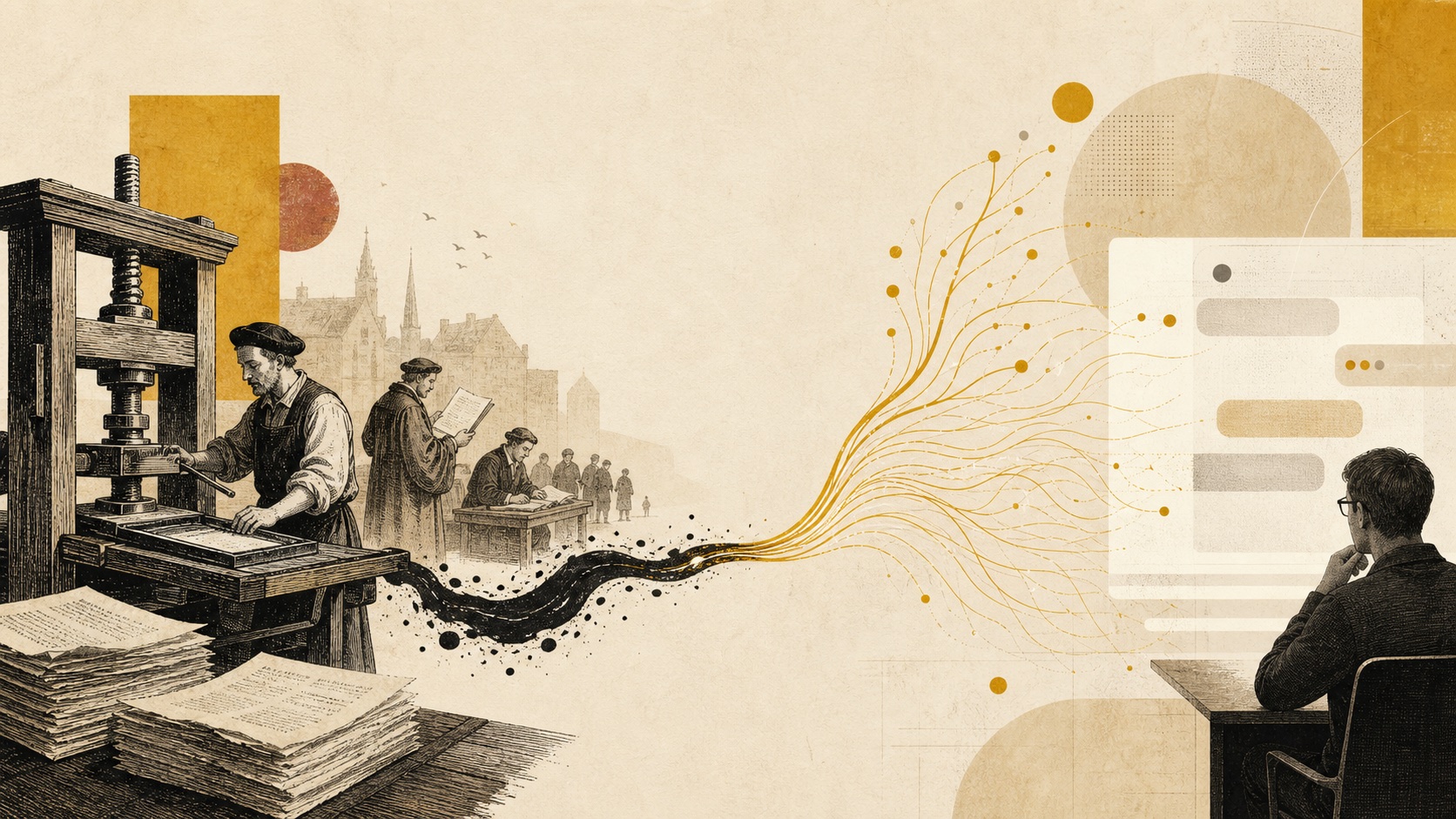
AI is not just changing what machines can do. It is changing how we understand our own value, our place in the world, and what it means to be human.
On Christmas Day in 1521, a communion wafer fell onto the floor of a church in Wittenberg.
This was not an ordinary Mass. Andreas Karlstadt had come dressed in the clothing of an ordinary person, not the vestments of a priest. He gave laypeople both the bread and the wine and invited them to take Communion even if they had not confessed. Many had not observed the required fast. Some were even said to have drunk brandy. About a thousand people reportedly came to participate in a service that openly broke with the religious practice they had known all their lives.
Unless you understand the world these people inhabited, those details can sound like minor violations of church etiquette.
They were not.
For a Christian in early sixteenth-century Western Europe, the Mass was the moment when a priest did something no ordinary person could do. He consecrated bread and wine. In the inherited theology of transubstantiation, the substance of the bread became the body of Christ while the appearances of bread remained. The wafer still looked and tasted like bread, but worshippers understood themselves to be encountering the real presence of Christ.
The priest’s vestments marked him as someone set apart for that responsibility. Confession prepared a person to receive the sacrament without approaching God while burdened by unforgiven sin. Fasting prepared the body for the encounter. Laypeople usually received Communion infrequently, often only at Easter. When they did receive it, they ordinarily received only the bread, placed in the mouth by a priest. These practices were not random rules layered around a symbolic meal. They expressed an entire understanding of the relationship between God, the Church, the priest, the body, sin, and salvation.
Karlstadt challenged almost all of it at once. His ordinary clothing questioned the spiritual difference between a priest and everyone else. Communion without confession rejected the requirement that communicants first seek forgiveness through priestly confession. Eating and drinking beforehand treated the required bodily discipline as unnecessary. Giving the wine to laypeople challenged a practice that had separated priest from congregation for centuries.
He was not simply asking them to treat the wafer as ordinary bread. At that point, Karlstadt still affirmed Christ’s real presence in Communion. He was asking them to inhabit a new account of who could approach and handle the sacred.
Then two consecrated wafers fell, one onto a man’s coat and another onto the floor. Karlstadt told the people to pick them up.
They would not.
These were not defenders of the old order. They had come because they believed reform was necessary. They were willing to defy the canons of All Saints, inherited ritual, and their own political ruler. Yet touching the Host meant touching what they had spent their lives believing was the body of Christ. That was a boundary their bodies would not let them cross. Karlstadt had to retrieve the wafers himself.1
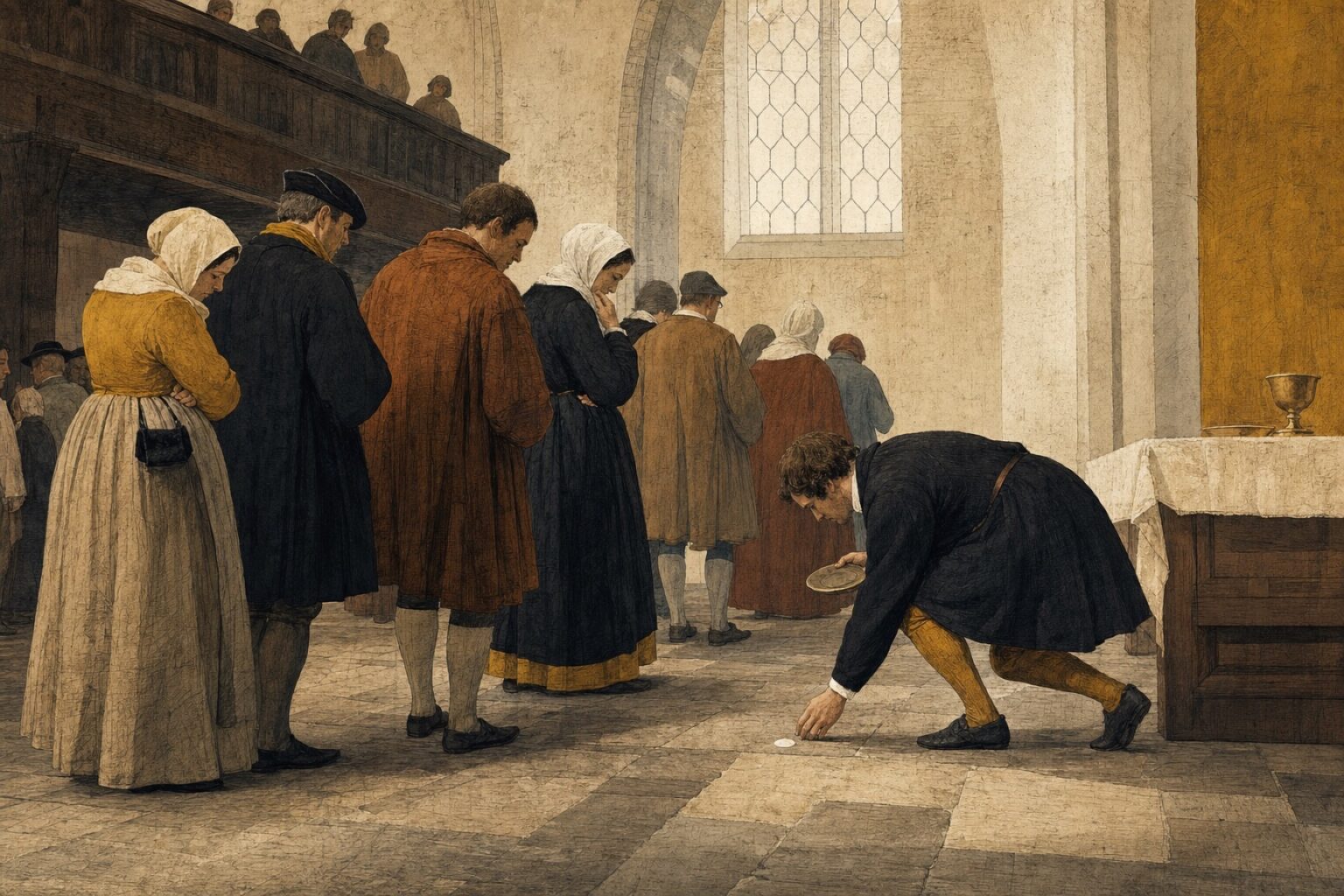
The people in that church had changed their minds before they had changed their instincts. They were ready to reject the old rules, but not yet ready to touch what those rules had taught them was sacred.
That is what a real change in worldview looks like. An old system can lose its intellectual authority before it loses its hold on the body.
This is not another technology
This is the part of artificial intelligence I think we are missing.
We keep comparing AI to the printing press, electricity, radio, the internet, and social media. Those technologies did astonishing things. They changed what people could do, how quickly they could do it, how far an idea could travel, who could speak, and how people behaved.
The crucial word is how. Those technologies also affected identity and meaning, sometimes profoundly. But their central effect was to change how human beings acted in the world. They changed the conditions of life without generally making people across almost every level of society wonder whether human contribution itself was becoming unnecessary.
AI is becoming a different kind of event because people believe it will not merely change their work. They believe it may eventually do their work better than they can and remove the need for them to do it at all.
Once that premise takes hold, the questions escalate quickly.
If AI can perform enough of my work to make my role unnecessary today, or will be able to soon, what is my place in the world? What is my purpose? What am I worth? If work is one of the main ways I contribute to other people, what happens when that contribution no longer requires me? What is a human life for then? Do human beings matter anymore? Do I matter? Will my children?
Those are not forecasts about what AI will actually accomplish. They are questions people can begin asking as soon as they believe replacement is coming. A life can be reorganized by an expectation before the prediction comes true.
Machines have threatened jobs before, sometimes on a vast scale. What is distinctive now is that generative AI has carried replacement anxiety into an unusually broad range of occupations built around language, interpretation, judgment, creativity, and leadership. The question can reach a manager, doctor, lawyer, teacher, artist, writer, programmer, executive, or public official in essentially the same form: if the ability that made me useful can be reproduced without me, where does my value now reside?
AI does not need to replace all of those people for the worldview to begin changing. It only has to make replacement feel plausible.
That is why I think the Protestant Reformation gives us a better comparison than the printing press.
I am not saying AI is a religion. I am not saying the twenty-first century will repeat the sixteenth. I am saying both events force people to reconsider a world that had made sense. They destabilize the institutions that explained what was true, who could know it, what made a life valuable, and where an ordinary person fit within the whole.
The printing press was an extraordinary technology that helped the Reformation spread. The Reformation was the crisis of meaning.
AI is the technology. The crisis gathering around it is about how we make meaning.
A world that made sense
To understand why the Reformation changed so much of western and central Europe so profoundly, we have to begin by taking the world before it seriously.
Many people in late-medieval Latin Christendom did not merely hold a list of Catholic beliefs. They inhabited a world in which visible and invisible reality were joined.
The church building made that world physical. A parishioner could look from the ordinary people crowded into the nave, to saints painted on a screen, to the crucified Christ above it, to images of the Last Judgment, heaven, hell, and purgatory. Beyond the screen, at the altar, the priest brought Christ into the church in the consecrated bread. Diarmaid MacCulloch describes this as a floor-to-ceiling account of the Christian story. Creation, sin, suffering, death, judgment, and eternal life were not ideas discussed somewhere else. They surrounded a person while that person stood in church.2
The same system organized life outside the building. Church bells marked the day. Fasts, feasts, Advent, Lent, Easter, and Christmas gave the year its shape. Baptism brought an infant into the Christian community. Confession and penance addressed sin. Church law helped govern marriage, sex, and inheritance. Guilds, monasteries, and confraternities joined work, charity, status, and prayer.
Purgatory offered an account of what happened to the saved who still needed to be purified after death. Masses, prayers, alms, pilgrimages, relics, and indulgences gave the living something meaningful to do for parents, spouses, children, and friends who had died. A family paying for a Mass was not simply purchasing a service from a church. Within that world, the family was still caring for someone it loved.
This was why the Church mattered. It did not merely tell people what to believe on Sunday. It explained where the dead had gone, why suffering existed, how guilt could be forgiven, which work was holy, who had authority, how time should be lived, and what a human life was for.
That system was neither uniform nor peaceful. Clergy could be corrupt. Popes pursued money and power. Local practices varied, and reform movements long predated Luther. Still, the late-medieval Church was not an empty shell waiting for one brave man to expose it. It met real spiritual needs. Even its abuses drew power from needs people genuinely felt.
That was true of indulgences. An indulgence addressed punishment for sins already forgiven. Within the larger account of confession, penance, and purgatory, it made sense. An indulgence campaign connected fear for the dead with papal authority, local politics, banking, and the financing of St. Peter’s Basilica in Rome.3
When Luther challenged the indulgence campaign in 1517, he pulled on a thread connected to almost everything.
At first, he was arguing about repentance, grace, punishment, and pastoral care. He was not yet presenting a complete new church. But the disagreement could not remain narrow because his opponents eventually made authority the issue. If the pope and the accumulated teaching of the Church supported the practice, what right did a provincial friar have to contradict them?
That question forced another: what if the pope was wrong?
Then another: what if a church council could be wrong?
Then another: what if the practices through which Christians had sought forgiveness, cared for the dead, distinguished holy lives, and understood salvation were not merely imperfect, but based on a fundamental error?
The controversy stopped being about the proper use of indulgences. It became an argument about who could say how reality worked.
Luther’s answer altered the structure of the Christian life. He argued that a person was justified by God’s grace through faith, not by accumulating merit. Scripture, not the pope or accumulated tradition, was the final authority against which doctrine had to be judged. Baptism and the shared priesthood of believers gave ordinary Christians a spiritual standing that did not depend on membership in a separate religious caste. Monastic vows did not create a higher class of Christian. Ordinary work performed in faith could be a vocation.
Each claim answered a theological problem. Together, they changed where a person stood in the universe.
Within Lutheran and other Protestant accounts, a monk or nun was not necessarily closer to God than a parent, farmer, merchant, or servant. Priests remained important, but no longer belonged to a spiritually superior estate. Clergy could marry. Care for the dead changed when purgatory and Masses for souls were rejected. Images that had mediated sacred presence could be condemned as idols.
A monk who had understood his vows as a path to holiness could discover that the path itself was a mistake. A nun who had been given to a convent by her family could be told that leaving, marrying, and raising children might be more faithful than remaining. A priest could become a husband and father. A family that had endowed Masses for its dead could learn that those Masses accomplished nothing. A craftsperson could hear that ordinary labor was a calling from God, while a student preparing for an ecclesiastical career could watch that entire career structure collapse.
This was not liberation in one clean direction. It was disorientation.
In Wittenberg, the changes moved so quickly that some students questioned whether their education had any point. The attack on private Masses threatened clerical livelihoods. When monasteries closed, land changed hands, men and women had to find new places in households and local economies, and poor relief had to be reorganized. When reformers removed images, they did not merely redecorate churches. They stripped away objects through which generations had understood sacred history and encountered the holy.45
Western and central Europe did not move together from one worldview to another. It fractured.
Catholics, Lutherans, Reformed Protestants, Anabaptists, and others offered incompatible accounts of the Eucharist, baptism, salvation, church government, and political obedience. Families divided. Refugees crossed borders. Rulers and churches built rival settlements through catechisms, schools, law, discipline, and force. Religious fracture became entangled with political revolt, state formation, persecution, and war. Catholic reformers also clarified doctrine, built institutions, and renewed their own account of authority.5
The world had not become meaningless. It had become a place in which the old sources of meaning no longer settled the most important questions.
The printing press helped claims move faster and farther. It made controversy cheaper to reproduce and harder to contain. But the press was not the thing that caused a priest to marry, a family to stop paying for Masses for the dead, a ruler to seize a monastery, or a worshipper to stare at an empty space where a saint had stood.
The Reformation did those things because it changed what the world meant.
The world AI found
The modern world is not united by one church, one theology, or one account of salvation. We disagree about religion, morality, politics, human nature, and almost everything else.
Yet our institutions still depend on a mostly unspoken account of the person.
We use human performance to distribute income, status, opportunity, and recognition. Schools reward writing, reasoning, memory, and problem solving. Professions issue credentials meant to prove knowledge and judgment. Employers pay more for abilities that are difficult to acquire and scarce in the labor market. People build identities around being able to do something that someone else needs.
Ask someone what they do, and the answer will usually be a job.
That is not an accident. For many people, work provides income, but it also provides structure, community, status, competence, and a way to explain one’s contribution. Becoming good at difficult work changes a person. The failures, repetitions, corrections, mentors, and unusual cases become part of how that person sees the world.
This account of human value has always been morally incomplete. A person is not worth more because that person writes better, calculates faster, remembers more, or earns a higher salary. Still, our schools, firms, professions, and labor markets regularly behave as though useful performance is evidence of both economic and personal value.
Then a machine begins producing the performance.
That is the disruption.
The most important thing about generative AI is not that it can make a document, image, plan, diagnosis, or recommendation more quickly. It is that those outputs often functioned as evidence of a human capacity. A finished essay implied that a student had read and synthesized. A legal analysis implied that a lawyer had interpreted. A diagnosis implied that a clinician had reasoned. A strategy implied that a leader had decided. A painting implied that an artist had imagined and made.
Now the artifact can appear without proving what we thought it proved.
That is destabilizing enough. But the fear goes further. If a machine can produce every economically valuable performance better than the people who once produced it, what are the people for? What is their purpose? Where do they find the recognition that tells them they matter? What is the meaning of a life that appears to be needed by no one?
AI did not invent the weakness in our assumptions. It exposed how much meaning we had asked work and performance to carry.
It does not matter yet whether the fear is right
AI cannot actually do all the things people fear it will do. It makes elementary mistakes. It invents facts. It often needs a human to define the problem, gather the right information, recognize an error, and take responsibility for the result. A strong performance on a benchmark does not mean a system can replace a person in the messy conditions of a real job.
All of that is true, but it does not answer the argument I am making.
I am not arguing that AI will eliminate every profession or that a machine is already more valuable than a person. I am arguing that a large number of people now fear that their future usefulness is being placed in competition with a machine. Because our institutions have taught people to locate identity, security, and recognition in useful work, I think that fear can become a question about personal value.
This is not a fringe anxiety. In 2025, Pew Research Center found that 52 percent of American workers were worried about AI’s future workplace impact, and 32 percent expected it to leave them with fewer opportunities. In a separate survey, 64 percent of American adults expected AI to mean fewer jobs over the next 20 years. Across 31 countries, Microsoft and LinkedIn found that 45 percent of knowledge workers worried AI would replace their job.7910
The fear reaches the next generation. In a 2026 study, Common Sense Media found that 57 percent of parents with children under 18 believed AI would make it harder for their children to find jobs. Nearly half of the young people surveyed worried about AI’s effect on their economic future, 49 percent thought it would make finding a job harder for them personally, and 59 percent thought people like them would have a harder time.11
Those surveys do not show that AI will cause mass unemployment. They do not show that workers believe their lives are literally worth less. They establish something important here: people already believe the ground is moving beneath them.
The anticipation becomes part of the event.
So, what happens when you believe there may be no job for you to get? What do you study? Do you borrow money for a degree? Do you spend years mastering a profession that may not want beginners by the time you arrive? Do you save for a future you cannot picture? Do you have children when you are not sure how they will support themselves or where they will find a place to contribute?
These questions can change decisions before any forecast is proved. In Deloitte’s 2025 survey of more than 23,000 Gen Z and millennial respondents across 44 countries, more than six in ten of the respondents who used generative AI worried that it would eliminate jobs and said the concern was motivating them to seek work they considered safer from disruption.12
The International Labour Organization offers an important counterweight. It estimates that one in four jobs worldwide has some exposure to generative AI, but says transformation is more likely than full replacement. Exposure is not disappearance. A task is not a job, and a benchmark is not a workplace.6
Still, the distinction between transformation and replacement does not settle the question of meaning. An OECD survey found that most workers using AI thought it complemented their abilities, while about half of the users in finance and almost half in manufacturing also believed it had made some of their own skills less valuable.8
Think about that. A person can become more productive and feel less valuable at the same time.
The fear is already entangled with people’s sense that they matter. In an American Psychological Association survey, workers worried that AI would make their duties obsolete were substantially more likely than other workers to say they did not matter to their employer or coworkers. The survey cannot prove that AI anxiety caused those feelings. It does show that fear of obsolescence and felt insignificance are arriving together.13
This is how a worldview begins to shift. The new account does not have to be true, complete, or stable. It only has to make the old account stop feeling certain.
When work stops explaining our place
Now imagine believing that the work through which you expected to contribute may no longer need you.
You do not have to lose your job for that belief to change you. A student can look at the field that once promised a future and wonder whether it is foolish to enter. A midcareer professional can look at years of accumulated skill and wonder whether the market will still recognize it. A parent can look at a child and wonder what preparation could possibly be enough. Someone choosing whether to start a family can wonder whether the next generation will have any economically useful place at all.
The actual labor market may eventually prove some of those fears wrong. It may produce new roles, new industries, and forms of work we cannot yet name. But a worldview is not only a description of what is objectively true. It is the set of assumptions through which people decide what is worth doing.
If I believe no employer will need my skill, the belief changes whether I develop it. If I believe entry-level work will vanish, the belief changes whether I pursue the profession. If I believe my children will enter a world in which machines outperform them at every economically valuable task, the belief changes how I imagine their future.
For many people, a job has been the most ordinary proof that there is a place for them. Someone needs what I can do. Someone will exchange part of the world’s resources for my contribution. Other people can describe me through the role, and I can describe myself through it.
When that proof becomes uncertain, the question is larger than, “How will I earn money?”
It becomes, “Where am I needed?”
The Reformation created a similarly profound disruption in vocation. Before it, monks, nuns, and priests occupied a religious estate set apart from ordinary household and economic life. Protestant reformers attacked that hierarchy. A monastery was not necessarily a place of higher holiness. Marriage, parenting, civic office, farming, craft, and household labor could all be callings in which a person served God and neighbor.
That change supplied one influential inheritance for the modern idea that ordinary work can express a calling. The later history is long and complicated, and our current habit of identifying ourselves with jobs cannot be credited to the Reformation alone. But the connection between work, identity, contribution, and purpose remains powerful. We want work to mean something because we want our lives to mean something.
AI presses directly on that connection.
The important issue here is not whether AI will actually eliminate a particular job. It is what happens when a teacher, programmer, designer, accountant, lawyer, doctor, manager, or writer begins to believe the activity through which that person contributed will no longer require a person.
The question changes from, “How will I do my work?” to, “Why would anyone need me to do it?”
That is the difference between a technological adjustment and a worldview-changing event. A new tool changes the method. The belief that human contribution itself is becoming unnecessary changes the person who imagined having a place in the world.
It is not only what AI is capable of doing that matters. It is what people think its capabilities mean about them.
What is a person worth when performance is no longer unique?
The Reformation forced people to ask how grace, faith, sacraments, penance, merit, and the Church’s mediation fit together in the relationship between a human being and God. What made one life holy and another ordinary? Who could speak with spiritual authority? What did freedom mean, and what obligations remained?
AI presses a different question, but one at a similar depth: why does a person matter?
For a long time, we have answered partly by pointing to abilities. Humans reason. Humans use language. Humans create art. Humans solve problems. Humans understand one another. Humans exercise judgment.
But even if a person had no grand theory of human uniqueness, there was usually a simpler answer available: I can do something that other people value.
For many people, some role, task, trade, service, form of care, or exercise of judgment offered a way to contribute. The work might not be glamorous or deeply fulfilling. It might even be miserable. Still, being needed offered a basic form of recognition. There was a place for me because there was something I could do.
Now a system can produce behavior associated with many of those abilities.
We can respond by moving the boundary. Perhaps humans reason better in unusual situations. Perhaps humans possess consciousness, embodiment, emotion, moral responsibility, relationships, or a lived history that a machine lacks. Those differences may be real and essential.
But notice what happens if our defense of human value remains a performance contest.
If people matter because they write better, then an improvement in machine writing weakens the argument. If people matter because they diagnose more accurately, the argument becomes vulnerable to the next medical benchmark. If people matter because they create beautiful images, every advance in image generation appears to subtract from human uniqueness.
That should make us question the argument, not the people.
A child does not have to outperform a model to possess dignity. A person with dementia does not lose value as memory fails. A disabled person is not less human because a machine can perform an activity that person cannot. A worker’s worth cannot be identical to the market scarcity of a skill.
AI is not making human life less valuable. It is exposing how often we confused value with superiority, dignity with productivity, and meaning with economic usefulness.
That could be a healthy correction.
It could also be brutally destabilizing in societies that distribute income, status, health, housing, and opportunity according to market value. Telling people that their dignity is unconditional does not pay a mortgage when an employer has decided their skill is no longer scarce.
The economic and existential questions therefore cannot be separated.
If work is one of the main places people experience contribution, and if our institutions treat productive output as the basis for security and respect, AI can create a crisis of meaning even while increasing total wealth. A society can become more productive while many of its members feel less necessary.
The problem is not simply that a machine might become more like a person.
The problem is that we built a world in which people were valued as imperfect machines.
AI makes that world harder to defend.
If a machine can eventually do all economically valuable work better than all of us, the fear is not merely that we will lose our salaries. The fear is that we will lose the most ordinary evidence that somebody needs us. What is my value then? What is my purpose? What is a life for when its contribution appears unnecessary? Those questions may rest on a false account of human worth, but that does not make them less real to the person asking.
A worldview is not replaced by proving that the old one has a flaw. It is replaced when people and institutions learn to live inside another account of who they are.
Where the comparison stops
The Reformation was not a technology. It was a collection of religious, political, economic, and social movements within Latin Christendom. It unfolded across generations through churches, rulers, cities, families, wars, markets, and competing doctrines. AI is a technology being deployed around the world in societies with very different histories and accounts of human meaning.
I am not arguing that a model company is a new church, a programmer is a new Luther, or a chatbot is a religion.
Nor am I arguing that radio, electricity, industrialization, the internet, or social media left human meaning untouched. They had enormous effects on human life and identity. But they primarily transformed our how: how we moved, worked, communicated, produced, consumed, and organized daily life.
AI can press more directly on our why. Why am I needed? Why does my work matter? Why should I develop an ability a machine may soon perform better? What gives a person purpose when useful performance is no longer distinctly human? The other technologies changed the conditions in which we pursued meaning. AI is beginning to make people question some of the sources from which they drew meaning in the first place.
The analogy is not between a model and Luther. It is between two periods in which an inherited account of a person’s place in the world stopped settling the most important questions.
The work of making meaning
Before we decide how to use AI, we need to understand what kind of change it is.
Treat AI as another technology and familiar questions follow. How do I use it? How do I work faster? Which skills should I learn? Which jobs will grow? Which rules should govern it?
Those questions matter, but they are about how.
They do not answer the question AI has placed underneath them: what really is my worth?
The Reformation matters as an analogy because it shows what happens when a civilization’s inherited answer to a question like that stops feeling certain. People do not simply update a belief and continue living as before. They reinterpret their past. They reconsider their obligations. They make different decisions about work, family, authority, education, community, and the future. The disruption travels outward from an altered account of who a person is and what a life is for.
The parent wondering whether a child will ever find work is not merely planning for a new labor market. The parent is trying to imagine whether the child will have a recognized place in the world. The professional afraid that years of expertise will become worthless is not merely calculating future income. The professional is asking whether the life spent developing that expertise still adds up to something. The young person looking at a machine that can write, code, draw, diagnose, and advise is not only choosing a major. That person is trying to identify a form of contribution that will still prove there was a reason to develop into someone.
We should not dismiss those fears by insisting that AI will create new jobs. It may. We should not intensify them by pretending we know that human labor will disappear. We do not.
The deeper problem is that both answers leave the same assumption untouched: a person’s worth depends on remaining economically useful.
As long as that is the answer, every improvement in AI will feel like a reduction in human value. Every new benchmark will move the boundary behind which we try to protect our importance. We will say that machines can write but cannot reason, then that they can reason but cannot judge, then that they can judge but cannot care. If our worth always rests on the next task a machine cannot perform, we have made human value contingent on the machine’s limitations.
That is not a stable place to stand.
We have to put the more difficult question at the forefront: what makes a human life valuable even when that life is not the most efficient way to produce an output?
Answering it will require more than reassuring slogans. We can say that every person has dignity, that relationships matter, that care matters, that experience matters, and that responsibility matters. But we also have to ask whether we believe those things deeply enough to live by them when productivity points in another direction.
This is hard work because the old account is built into us.
Return one last time to Wittenberg.
The people at Karlstadt’s service had accepted enough of the new theology to break rules that had ordered Christian practice for generations. Yet when the wafer fell, the old world was still present in their hesitation. Their explicit beliefs had changed before their embodied understanding of reality had changed.
We can see the same divide in ourselves.
Most of us would reject the claim that a person’s worth equals a salary, a title, or the scarcity of a skill. We know that a child matters before the child can work. We know that an older person does not become worthless upon retirement. We know that illness, disability, unemployment, or dependence does not erase someone’s humanity.
Yet when a machine performs a valued skill better or faster, many of us feel the threat personally. We do not experience it merely as a new method. We experience it as evidence that we may be worth less.
Our stated belief is that human value exceeds useful performance. Our reaction reveals how much of the old worldview remains in the body.
Saying that the old account of our worth was flawed is not enough. We have to learn to live inside another account of who we are.
If we can answer the question of human worth in a way that survives being outperformed, we do not have to treat every advance in AI as evidence of our own disappearance. We may still have serious reasons to worry about jobs, income, power, and inequality. But we will not have to confuse the loss of a task with the loss of a self.
If we cannot answer it, we will keep defending our value through whatever work machines have not yet mastered. That territory may continue to shrink. Long before every job is actually replaced, we may experience ourselves as replaceable altogether.
And then the question, “What is the point of life?” will no longer sound rhetorical.
The printing press, radio, electricity, the internet, and social media changed what people could do and how they could do it. AI is changing how people understand their own purpose, value, and place in the world.
AI is changing the why.
Notes and sources
- Lyndal Roper, Martin Luther: Renegade and Prophet (Random House, 2017), chapter 10, especially pp. 218–224 and 235. Roper describes Karlstadt’s Christmas 1521 service, its theological and political context, the dropped wafers, and the communicants’ refusal to touch them. Roper also notes that the brandy story came through hostile reporting and was later repeated by Luther.
- Diarmaid MacCulloch, The Reformation: A History (Penguin, 2005), introduction and chapter 1, especially “Seeing Salvation in Church” and “The First Pillar: The Mass and Purgatory.” MacCulloch reconstructs the late-medieval Church as a vigorous system in which the physical and spiritual, the living and dead, and everyday and eternal life were joined.
- Roper, Martin Luther, introduction, especially pp. 1–6, on the social, sacramental, political, and financial system surrounding the indulgence campaign. See also MacCulloch, The Reformation, chapter 3.
- Roper, Martin Luther, chapters 9–10, especially pp. 218–230, on the Wittenberg reforms, the collapse in university enrollment, threats to clerical careers, changes to poor relief, iconoclasm, and the struggle over secular authority.
- MacCulloch, The Reformation, introduction and chapters 4, 14, and 16, on uncontrolled early reform, the Peasants’ War, confessionalization, institutions, family, vocation, and everyday life. See also Roper, Martin Luther, chapters 12–13 and 16.
- International Labour Organization and NASK, “Generative AI and Jobs: A Refined Global Index of Occupational Exposure” (2025). The report estimates that one in four jobs worldwide has some exposure to generative AI while emphasizing that transformation is more likely than full replacement.
- Luona Lin and Kim Parker, “U.S. Workers Are More Worried Than Hopeful About Future AI Use in the Workplace,” Pew Research Center, February 25, 2025.
- OECD, “The Impact of AI on the Workplace: Main Findings from the OECD AI Surveys of Employers and Workers” (2023). The surveys covered more than 5,000 workers and 2,000 employers in finance and manufacturing across seven countries.
- Pew Research Center, “How the U.S. Public and AI Experts View Artificial Intelligence” (April 3, 2025). The survey included 5,410 U.S. adults and a separate sample of 1,013 AI experts.
- Microsoft and LinkedIn, “AI at Work Is Here. Now Comes the Hard Part,” Work Trend Index Annual Report (May 8, 2024). The findings draw on a survey of 31,000 knowledge workers across 31 countries.
- Common Sense Media, “Generation AI: What Kids and Families Think About AI” (March 2026). The national U.S. study surveyed parents and young people ages 12 to 17 about AI, education, employment, and the future.
- Deloitte, “2025 Gen Z and Millennial Survey” (May 14, 2025). The survey included 23,482 respondents across 44 countries.
- American Psychological Association, “2023 Work in America Survey: Artificial Intelligence, Monitoring Technology, and Psychological Well-Being” (2023). The association between obsolescence worry and feeling insignificant at work is correlational.