

Does American politics ever feel like an enormous amount of effort spent on getting nowhere?
You can watch a member of Congress deliver a spectacular denunciation of everything that’s wrong with Washington. Maybe you’re nodding along. Maybe you’re exhausted before they’ve finished the first sentence. Either way, when it’s over, you’re left with a common question: did anything happen?
Someone certainly had a good television appearance. Whether the rest of us got anything out of it is harder to tell.
When I spoke with Yuval Levin, director of social, cultural, and constitutional studies at the American Enterprise Institute, I asked whether some members of Congress eventually give up on the job they ran for.
I could imagine the sequence. Someone runs for office intending to represent people and accomplish something. They get to Washington, discover how little they can change, and begin thinking about what comes next. “If this place is so screwed up and the reality is that things will never change, I can at least do well for myself.” They start making noise. They raise their profile. And when they’re out of Congress, perhaps a television job. Maybe a book deal.
In my conversation with Yuval, I didn’t want to assume that everyone who enters politics is running a scam. Most probably arrive wanting to do the work. And someone can arrive sincere without remaining immune to disappointment. Spend enough time trying to accomplish something, watch other people get rewarded for an activity that looks considerably easier, and you may start reconsidering how you’re spending your days. You don’t have to wake up one morning and decide to become a villain. You can just keep adjusting.
Yuval’s answer challenged my picture of the frustrated legislator giving up and preparing for a television career. Ambitious people try to succeed, he pointed out. What does Congress make available as a way to succeed? If the institution limits your opportunities to do serious legislative work, but your title still attracts an audience, where do you put your ambition?
And that, constant reader, raises a possibility worse than the one I started with. Your representative’s alternative career doesn’t have to begin after they leave Congress. It can begin while they’re still there…while they ostensibly are in the public service and dedicated heart and soul to working for your interests.
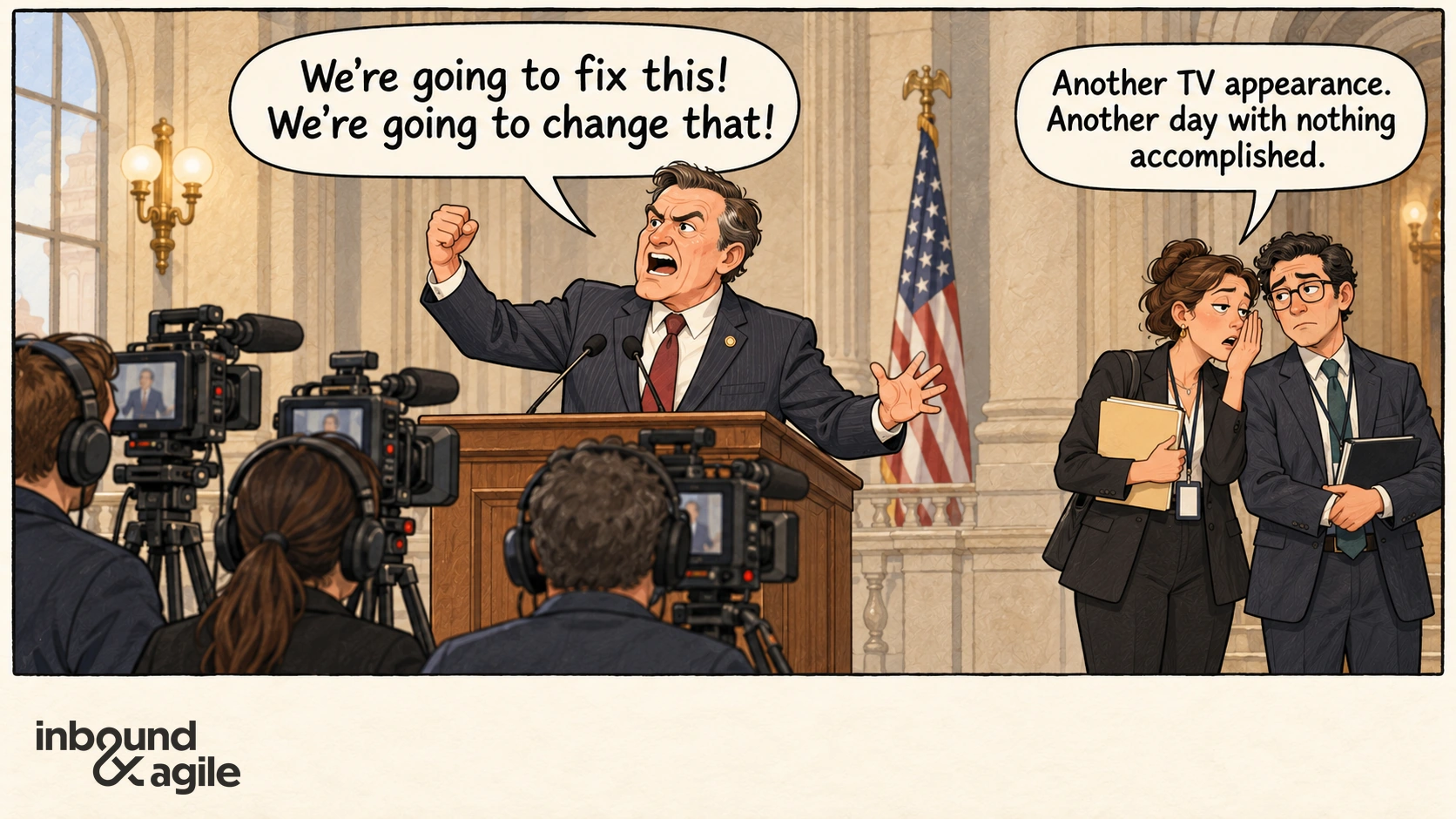
And unfortunately, isn’t this how we sometimes feel when we see some of these big names on TV “owning” the other side, but no actual legislating going on in Congress?
The office supplies the title, the access, the hearing room, the camera, and a rotating cast of people to be appalled by. Your representative doesn’t necessarily need to solve the problem to remain its most recognizable opponent. Another failure can give them another occasion to explain how hard they’re fighting, how unreasonable everyone else is, and why they need your support.
Congress can have a terrible week while the congressperson has an excellent one.
With the November 3 midterms approaching, we’re about to make consequential decisions about who gets those offices. Their positions matter. So does their character. But the question that interests me is what happens after they win. Will getting ahead require them to become better at governing with other people? Or can they do just as well explaining, indefinitely, why those people make governing impossible?
What does the job let you do?
Yuval’s diagnosis begins with the concentration of power inside Congress. As party leaders gain control over the agenda, ordinary members have fewer opportunities to turn expertise and negotiation into influence. Becoming unusually good at a policy area offers less of a career path if you can’t get that work considered.
That can sound like an excuse politicians make for themselves. You have an office in the United States Congress, a staff, and a vote. How powerless can you possibly be?
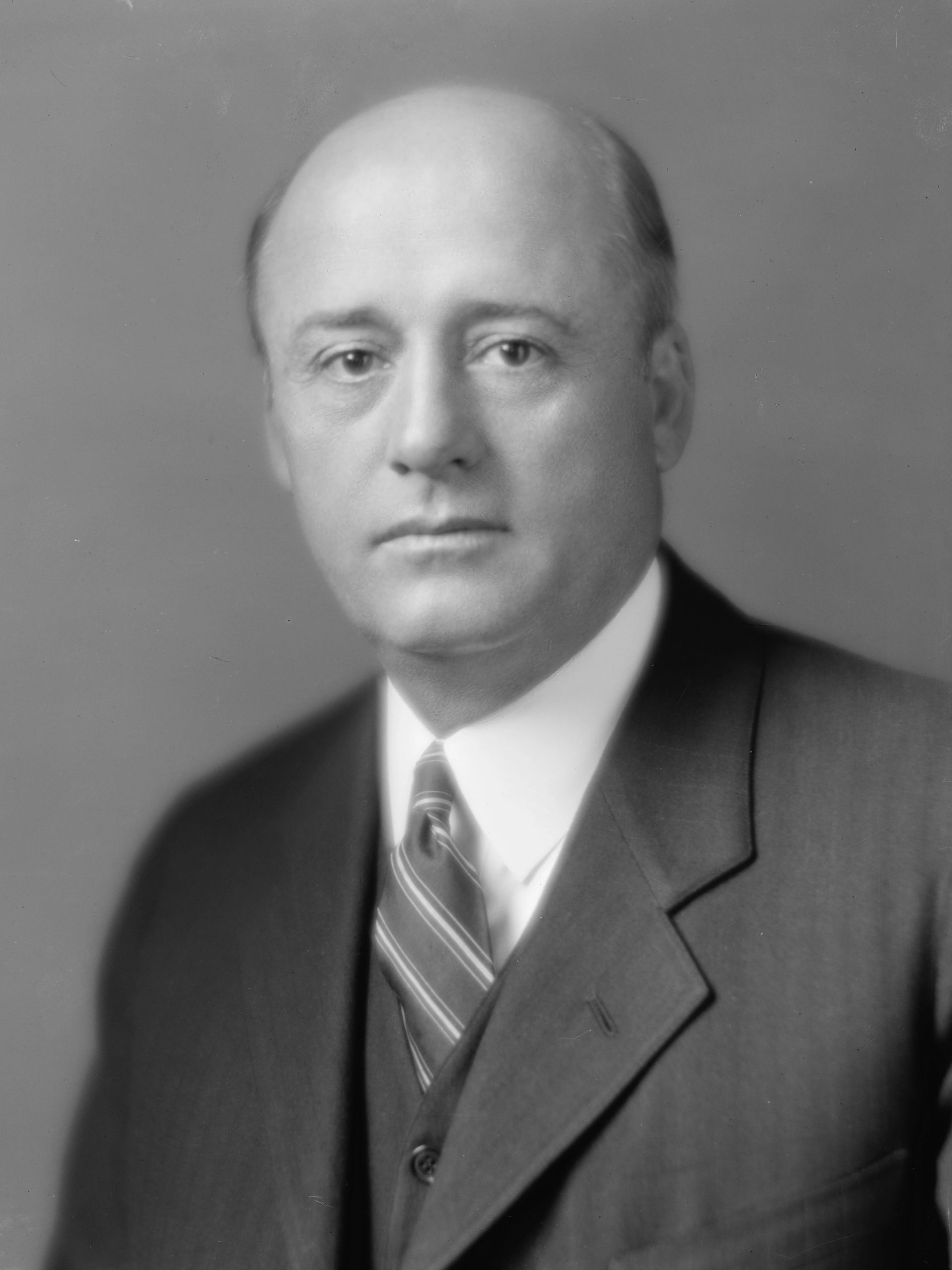
We can go further back, but for the sake of brevity, let’s start in 1961. Sam Rayburn was Speaker of the House. His fellow Democrat John F. Kennedy was entering the White House. Democrats held a substantial House majority. You might think they could at least get their program to a vote.
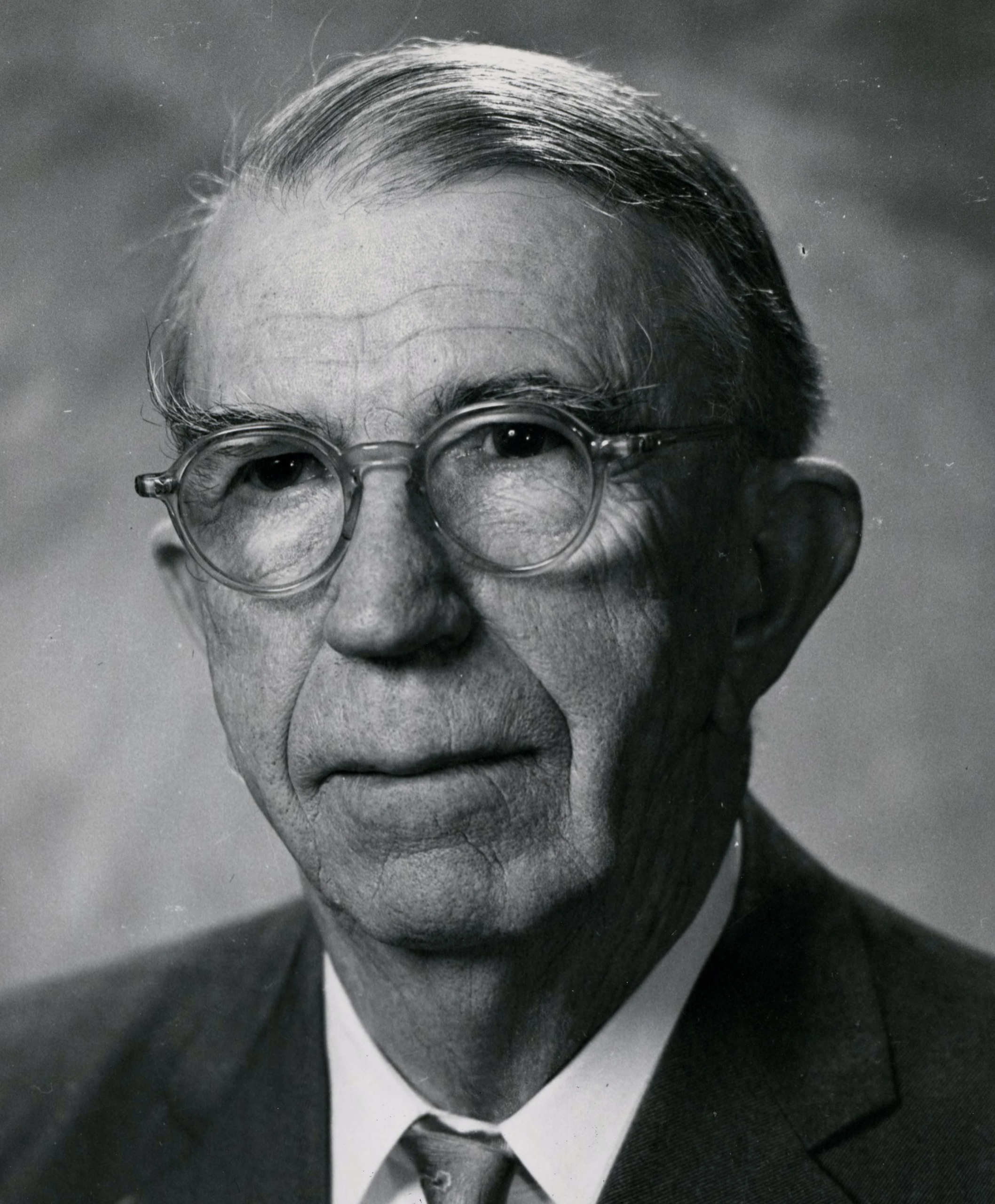

But another Democrat, Howard Smith, chaired the Rules Committee, which controlled whether much of that legislation could reach the floor. Democrats held eight of its twelve seats. Smith and fellow southern Democrat William Colmer could join the four Republicans to produce a six-to-six deadlock. Rayburn could have a majority in the House and still be unable to get key bills to a vote.
His solution was to change the arithmetic. He pushed to enlarge the committee from twelve members to fifteen, adding two Democrats and one Republican. After a bitter fight, the House approved the change, 217–212. It didn’t guarantee Kennedy’s bills would pass. But, it did reduce Smith’s ability to keep the House from deciding.
In the 1970s, reform-minded Democrats confronted powerful chairs across the committee system. They made chairmanships subject to secret-ballot votes in the party caucus. In 1975, House Democrats voted three entrenched chairs out of their chairmanships. Junior members gained more room to work through subcommittees. Yet the same reform period strengthened Speaker Carl Albert. He gained authority to nominate the Rules Committee’s chair and Democratic members, subject to caucus approval. The House still formally elected the committee. Members could do more inside committees while leadership gained a firmer grip on what came out of them.
By the 1980s, Speaker Tip O’Neill and his successors faced a different headache. More members wanted to offer amendments, and Republicans were using floor tactics to disrupt Democratic plans and force embarrassing votes. Democratic leaders responded by using the Rules Committee to restrict which amendments could be offered. The reforms that had opened up participation were followed by measures to contain it. From leadership’s perspective, this made the House more manageable. From a member’s perspective, it meant another decision about their work was being made before they got to the floor.
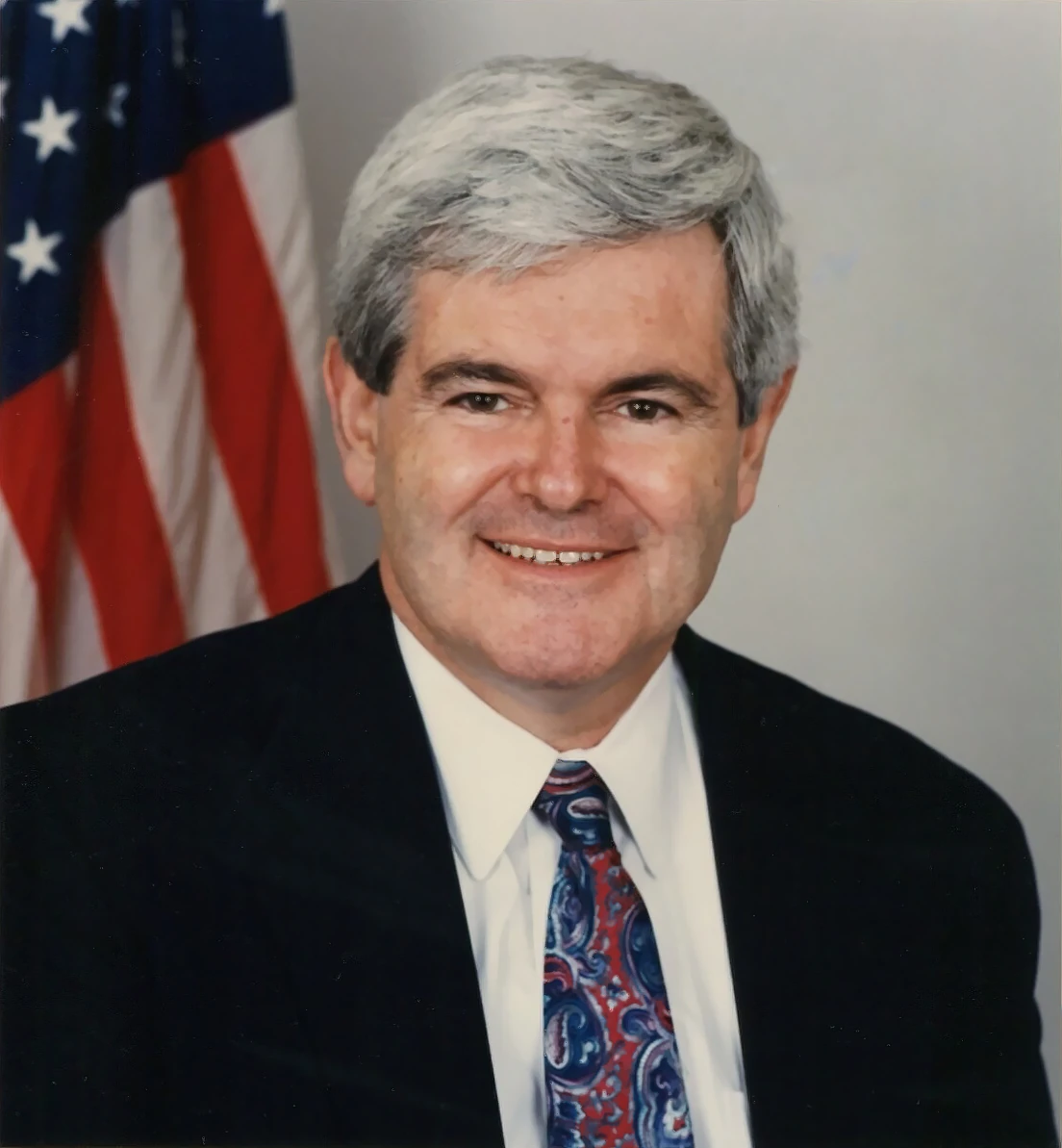

Then, in 1995, Newt Gingrich became Speaker with a new Republican majority and a promise to bring the Contract with America to House votes within a hundred days. Leaving the timetable to independent committee chairs would have put that promise at their mercy. He bypassed seniority in selecting some chairs and used leadership task forces to develop legislation outside the standing committees. And, new six-year limits on committee chairmanships also made it harder for a chair to build a permanent power base. Gingrich had spent years fighting Democratic control of the agenda. In office, he tightened the leadership’s control over it.
There isn’t an uncomplicated golden age to return to though, and there’s a lot more to all of the stories I’ve just shared. The accordion of consolidations and redistributions of power is ongoing. A change that frees members from one person’s control can make them more dependent on someone else. In the timeframe that is most important to us, recent history and now, more of those decisions have moved toward party leadership.
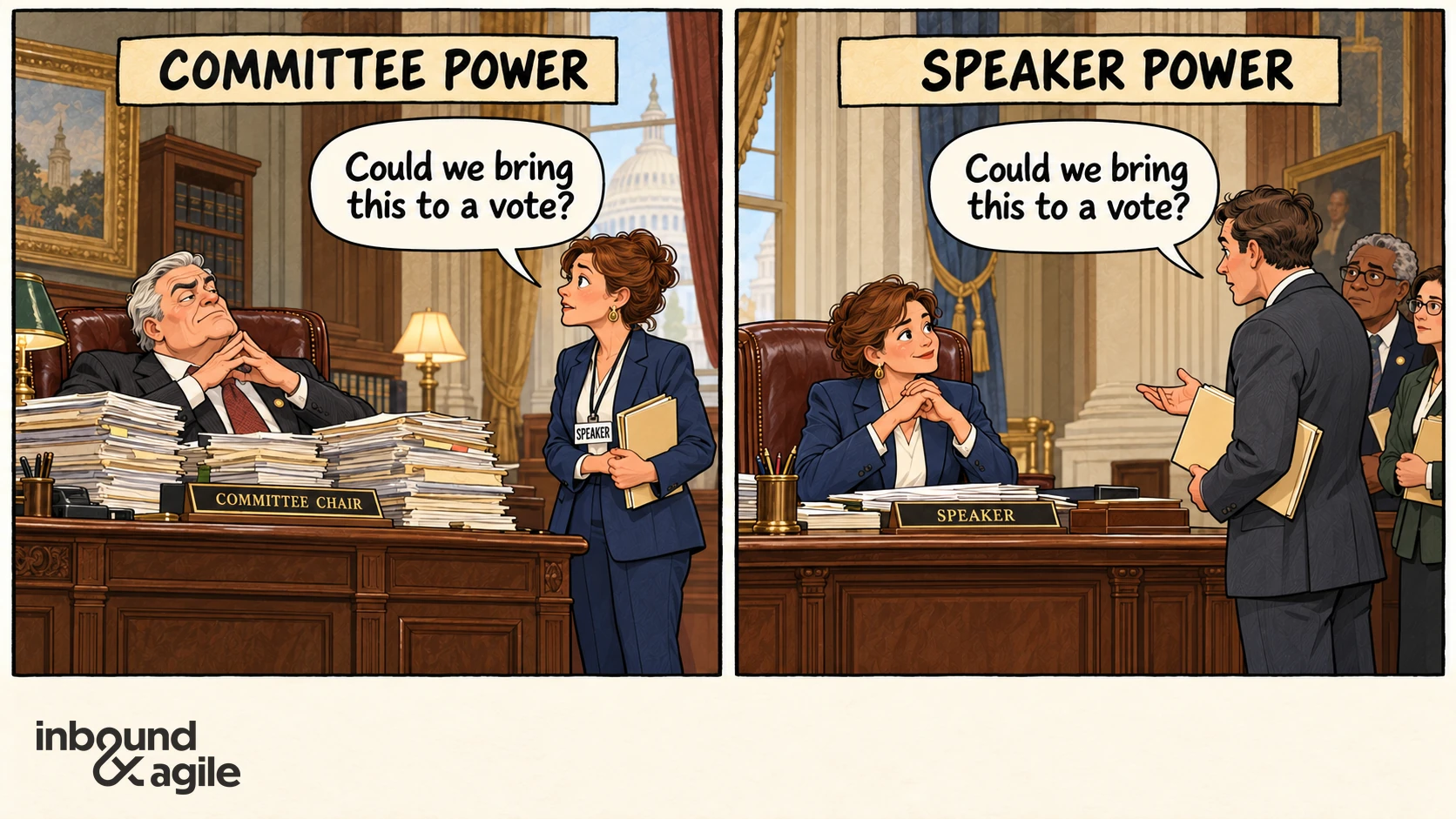
Take a seemingly modest goal: your representative wants to change a bill. They’ve studied it, drafted an amendment, and found colleagues who agree. The next step is a debate and a vote, right? Not so fast, buster.
Getting permission to offer the amendment can be a fight of its own.
The Congressional Research Service’s 2022 explanation of House floor amendments lays out the sequence. For major bills, the Rules Committee, working with majority-party leadership, proposes the terms of debate. Under a structured rule, those terms specify which amendments members will be allowed to offer. Members submit their proposals to the committee and try to get them included.
Then the full House votes on the rule. Once it adopts that rule, the permitted amendments can come up for debate. An amendment left off the list ordinarily doesn’t get its own floor debate and vote.
So, let’s be clear. Your colleagues may have read your amendment. They may even support it. The obstacle isn’t necessarily persuading them that it’s a good idea. It’s getting permission to put that idea before the House for a decision. A vote approving the debate rules can close off your proposal without anyone having to vote on its substance.
You are a duly elected member of Congress. You’ve been sent to Washington to represent your constituents and to legislate. Maybe you’ve spent months researching a topic, drafting an amendment, and drumming up support. But all of that can come to nothing because the Rules Committee leaves your amendment out and the House accepts those terms. Your colleagues vote on the process. They never have to debate your idea.
So, what do you think you would be inclined to do? Keep fighting the good fight? Or, perhaps give in to a little disillusionment?
Now, there are good reasons to organize the work of Congress. A legislature with hundreds of members cannot consider every suggestion indefinitely, and party leaders are elected by their colleagues. Coordination isn’t inherently a theft of authority. But controlling the agenda also means controlling which kinds of effort have a chance to pay off.
The man who took over the debating club
Long before Lyndon Johnson managed the Senate’s schedule, he took over a debating club. Its members could argue about legislation, vote on it, and go home. Nothing they voted on became law.
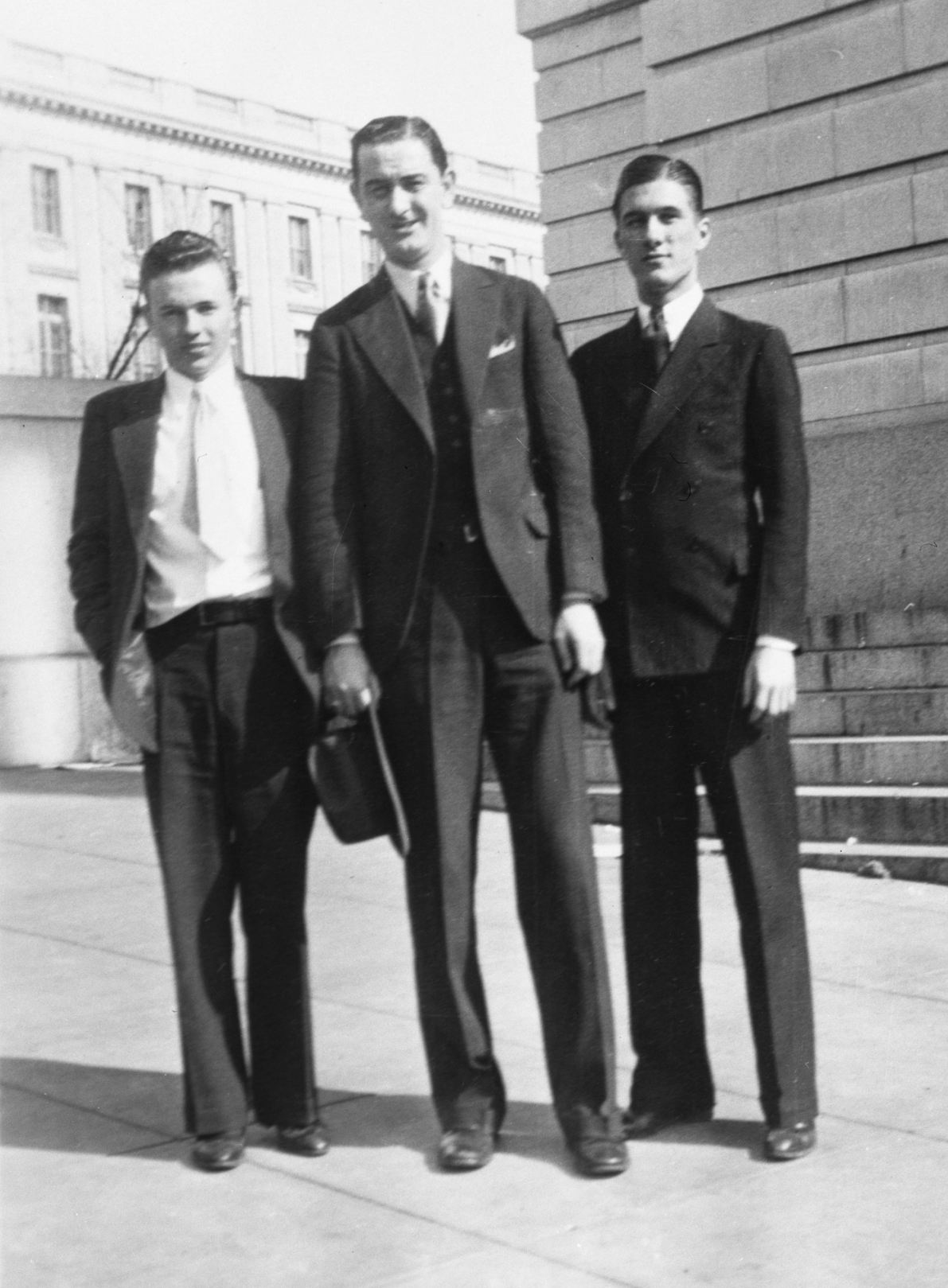
Robert Caro tells the story in The Path to Power. In 1933, Johnson was a twenty-four-year-old congressional aide. The Little Congress was a society where aides could practice speaking and parliamentary procedure. By then, a few dozen people might turn up at its monthly meetings. Officers advanced through an orderly succession, and the next Speaker was supposed to be the person whose turn had come.
Johnson had no interest in waiting for his turn. He quietly recruited newly arrived aides and found that the bylaws allowed other employees on the legislative payroll to join too. Mailmen and elevator operators appeared at the election. He won. Older members challenged some voters’ eligibility and accused him of stealing it. All this for a debating club.
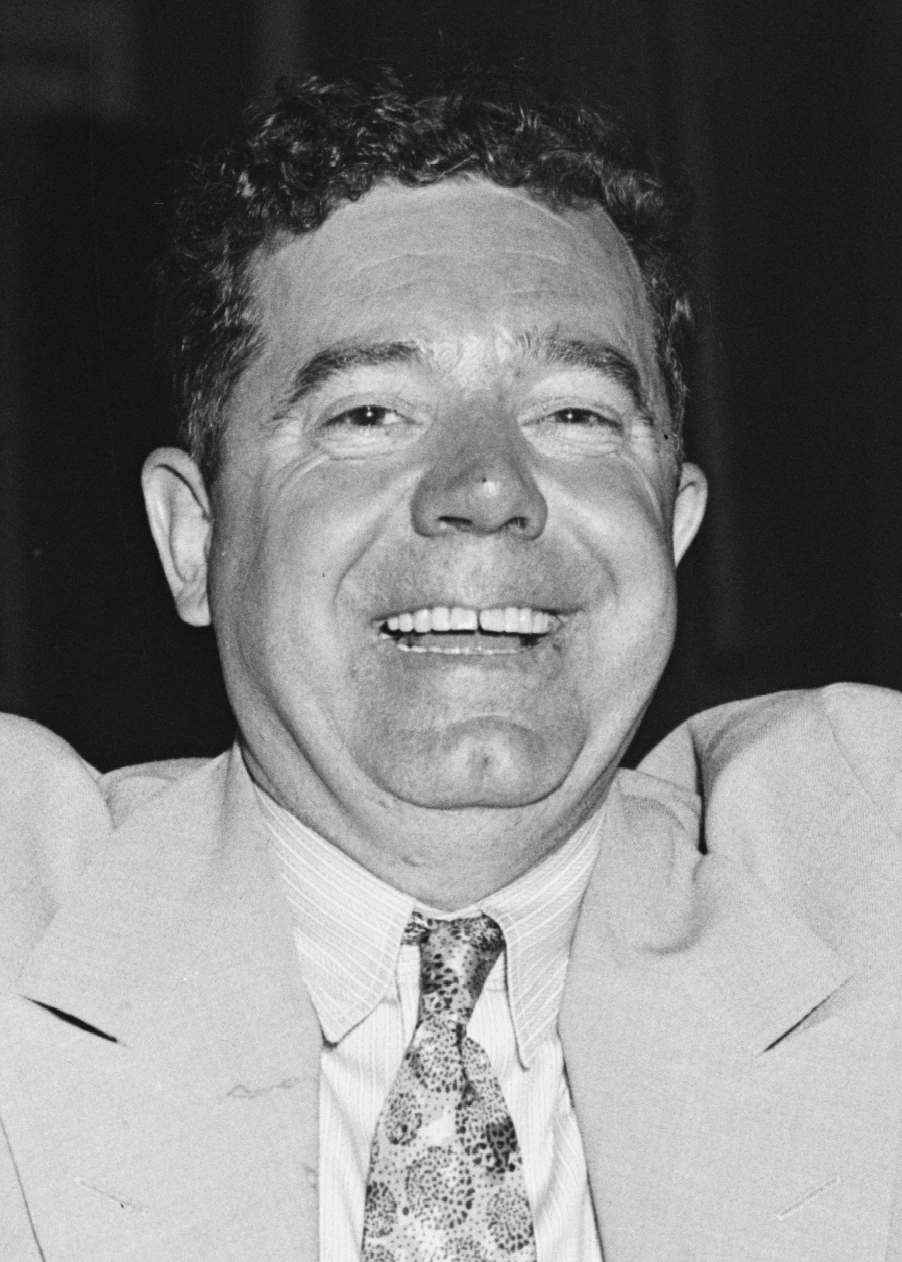
But winning an obscure title was only the beginning. He changed monthly meetings to weekly ones, invited prominent politicians, and organized debates on legislation the real Congress was considering. Reporters had a reason to attend: the aides preparing their bosses for actual legislative fights were rehearsing the arguments. Crowds grew to two hundred or more. Huey Long came to speak, accompanied by the cameras and attention Johnson wanted.
And Johnson controlled the opportunity. Previously, anyone could speak. Now, he assigned the speakers. Even after his one permitted term ended, he maintained control through successors. People who opposed his candidates could find themselves left out of future debates. He had made the club worth participating in, then made the chance to be heard depend on him.
When he reached the actual House in 1937, he couldn’t simply repeat the takeover. Seniority stood in his way. But in the 1940 election, Democratic candidates needed campaign money, and Johnson had access to wealthy Texas backers. Given a modest assignment to assist the congressional campaign committee, he brought in $45,000 within a week. Donor instructions directed the money to recipients on lists he had prepared. The committee chairman signed the checks. Johnson sent telegrams ahead of them so recipients would know who had arranged the help. He hadn’t become Speaker. He had become someone colleagues had a reason to remember.
In the Senate, the things colleagues needed included committee seats and a chance to get their bills considered. As Democratic leader in 1953, Johnson helped newly elected senators onto major committees instead of making them wait years. That created opportunities. It also made Johnson the person who could provide them. Caro follows both sides of this bargain in Master of the Senate.
Consider a banking bill in 1955, when Johnson was majority leader. Banking Committee chairman William Fulbright and his colleague A. Willis Robertson wanted it through the Senate without amendments that could undo their work. Johnson told Robertson he would not move it to the floor without assurance that amendments would be dropped. Senators who wanted the bill to pass gave up most of their proposed changes. When Robertson reported that the three remaining amendments could be defeated, Johnson accepted that arrangement. The committee’s leaders got help moving their bill. Johnson gained control over how it moved.
There is no innocent age of politics hiding in this story. Johnson sought publicity, rewarded loyalty, and made colleagues dependent on him. But notice what they needed him for: access to money, committees, and legislative decisions. His influence grew because other people were trying to accomplish something and he could help or hinder them. Concentrating authority could make the institution work more effectively while leaving individual members less independent.
For a less powerful member, the gap between the title and the work can be harder to escape. Suppose you’ve spent months understanding a problem and finding colleagues who might support a solution. If all of that effort rarely gives you a path to any kind of decision or resolution, the institution is teaching you how you should or should not spend your time and effort in the future.
You still have your title. You can still speak. You can still become famous. You just can’t actually do much of what you got into politics to do.
Under those circumstances, becoming better known might start to look like the sensible part of the job. At least you can see whether it’s working.
When refusal becomes useful
Put yourself back in the position of the member whose amendment never made the list. You still have to return home and explain what you’ve been doing. Congress has made one kind of accomplishment difficult. It hasn’t made every kind difficult.
Imagine you’ve promised to help communities replace deteriorating water systems. The need is real. People have been waiting. The campaign promise wasn’t especially complicated: fix the pipes.
Then comes a possible deal. In this hypothetical, it would help some communities now, but others would have to wait. To get enough votes, you’d also have to accept a spending concession you campaigned against. Now you have to explain who gets help, who doesn’t, and why you agreed to something you recently criticized. Someone from the other party gets to stand beside you and claim credit. One of your own supporters asks why you didn’t hold out for more.
Now imagine walking away and announcing that Washington refuses to fix the pipes.
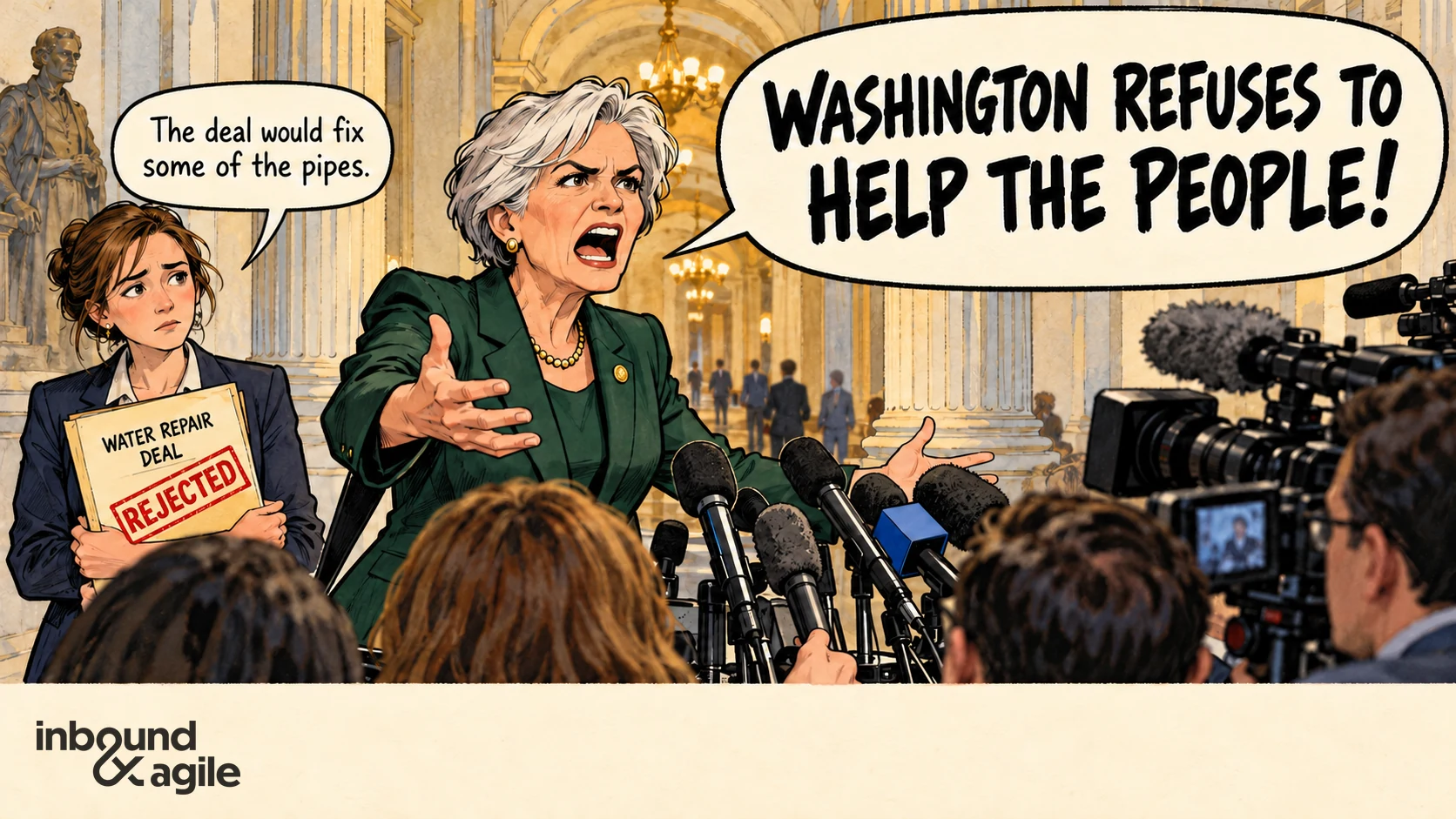
You can probably hear that speech already. The need is urgent. The opposition is disgraceful. You refuse to back down. For the people waiting on clean water, the difference is consequential. For someone watching a short clip, the refusal may look more committed to helping them.
Some deals deserve to fail. But notice how much easier it can be to explain the refusal than the achievement. A compromise comes with things to defend. An unfulfilled demand can remain perfect.
Building an audience around failure can work with people who already share the frustration.
Passing the bill requires cooperation from people with different demands. If I need your vote, I have a reason to understand what you need. Your objection might reveal a defect in my proposal. Even if I remain convinced that you’re wrong, your ability to withhold something I need forces me to decide what I’m willing to change to get a result.
This is what gets lost when a few leaders do the bargaining and most members are left to defend or denounce the result. Members get less practice working through those disagreements themselves. Meanwhile, an audience is available that will reward them for having made no concessions at all.
Who is all that applause coming from?
A leader can keep your amendment off the floor. You don’t need that leader’s permission to post a video about it. That gives a member a way to challenge concentrated power. It also gives them a way to live quite comfortably with it.
A 2025 Center for Effective Lawmaking working paper, led by Michael Kistner and colleagues, examined congressional communications from 2009 through 2022. In their models, negative partisan attacks received roughly twice the retweets and Facebook shares of a member’s average message. Yet the researchers generally found no corresponding increase in approval among constituents overall. There was a positive association among constituents of the member’s own party. Picking fights could look successful to the people already on your side without improving how the constituency as a whole judged your work.
An online following can also gather around a narrow preference, and its members may live nowhere near the district. None of them needs to be fake for the signal to be misleading. They can be sincerely delighted by something that does very little for the people the member was elected to serve.
Nor does the member have to notice whose approval they’re collecting. In a twist on the famous New Yorker cartoon:
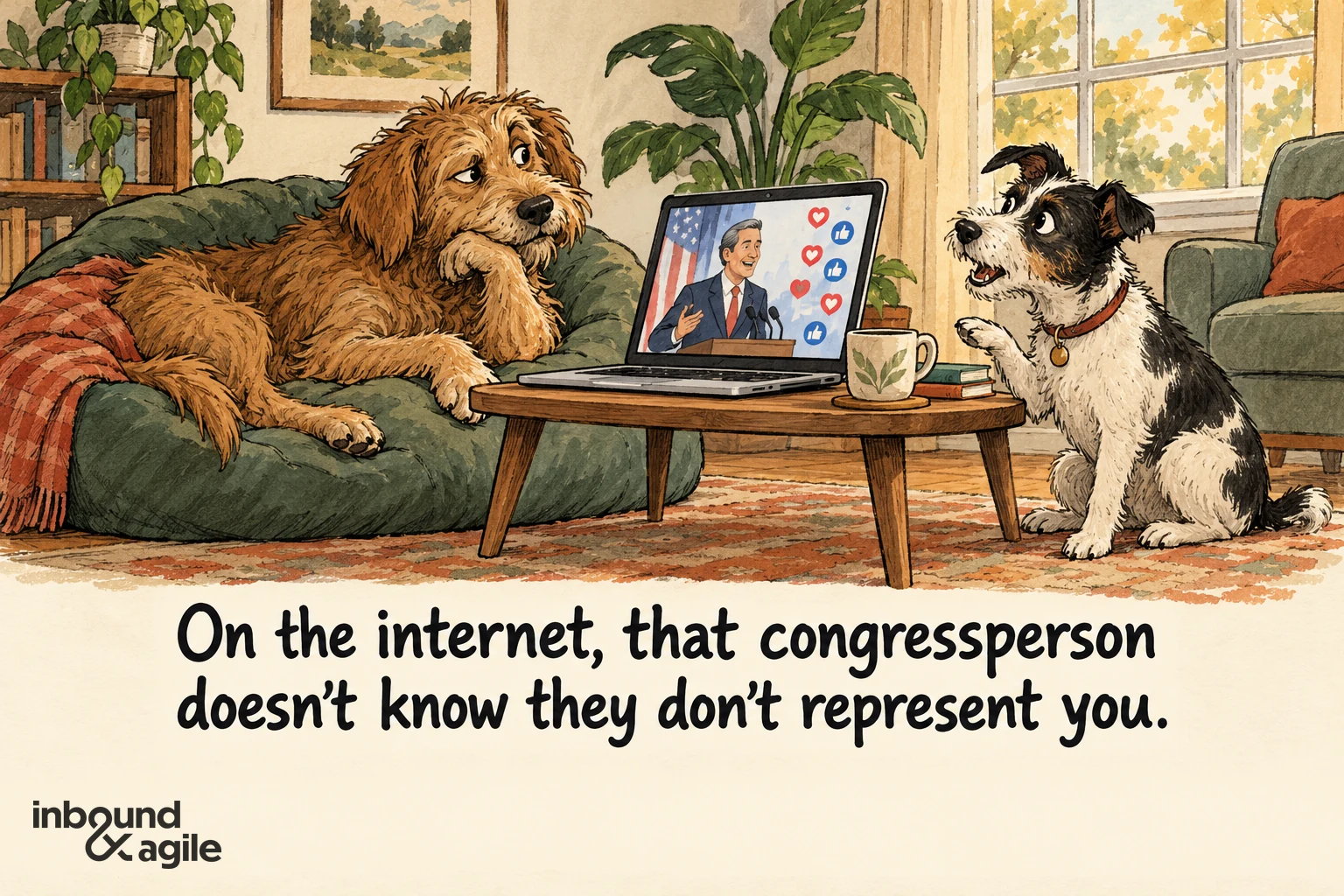
A political career can become successful enough on its own terms that failure to govern stops being something the politician needs to correct. It becomes something they know how to use.
And then who has a reason to reopen the legislative process? Leaders would have to give up some control. Members who thrive on denouncing the results would have to take more responsibility for producing them. The people with the clearest reason to want a different arrangement may be the ones still waiting for the pipes.
Being loud isn’t the test
None of this means a member shut out by leadership should accept their exclusion politely. Publicity can force an ignored problem onto the agenda. A sharp hearing can expose something we’d otherwise never learn. Outside pressure may be the only way a member can get someone with authority to pay attention.
What we need to see is a purpose for the attention beyond getting more of it. If the member is mobilizing pressure, what are they asking someone with authority to do? What would count as progress? When the strategy fails, what do they try next?
Sometimes the purpose is to prevent something. Blocking a harmful law is real work. So is oversight, and so is helping constituents receive benefits they’re owed. Congress could pass a great many terrible bills and become highly productive in exactly the wrong sense. An agreement doesn’t become good just because both parties sign it, either. Powerful people can agree at someone else’s expense.
The question is whether members have meaningful ways to influence those decisions, and whether they use them. We can demand more of our representatives while also demanding a Congress in which doing the work gives them a chance to accomplish something.
Make cooperation worth the trouble
At this point, it’s tempting to simplify this and say that we just need better people. Less vanity. More courage. Someone who will do the work even when the work is difficult and the rewards go elsewhere.
I’d like those people too. But if we keep narrowing the route through which serious effort can accomplish anything, we’re making the job harder for precisely the people we say we want.
Members need usable opportunities to turn expertise and agreement into decisions. Can a committee’s work reach the floor? Can a member obtain consideration for a serious amendment? If they persuade colleagues across factions, does that earn an opportunity to act, or merely an invitation to wait?
The House has experimented with this idea. Its Consensus Calendar, as described by CRS for the 2021–2022 Congress, offered a conditional route toward floor consideration for bills with at least 290 cosponsors that remained unreported by their main committee. Both measures designated from the calendar for floor consideration passed the House, but neither became law.
Attaching your name to a bill isn’t the same as negotiating an agreement or committing to move it. The calendar’s limited results don’t establish a cure. But the design asks a useful question: can persuading colleagues to support a proposal buy access to a decision?
Yuval emphasizes the value of bargaining, and this is where I think we have to be careful. Making agreement harder can encourage negotiation when the participants need an outcome. It can also make obstruction more rewarding when they don’t.
Imagine being told that the delay is good because it forces everyone to take your interests seriously. That sounds reasonable until you’re the person still waiting on the water system, and the people prolonging the argument aren’t paying much of a price for it.
Who bears the cost of waiting?
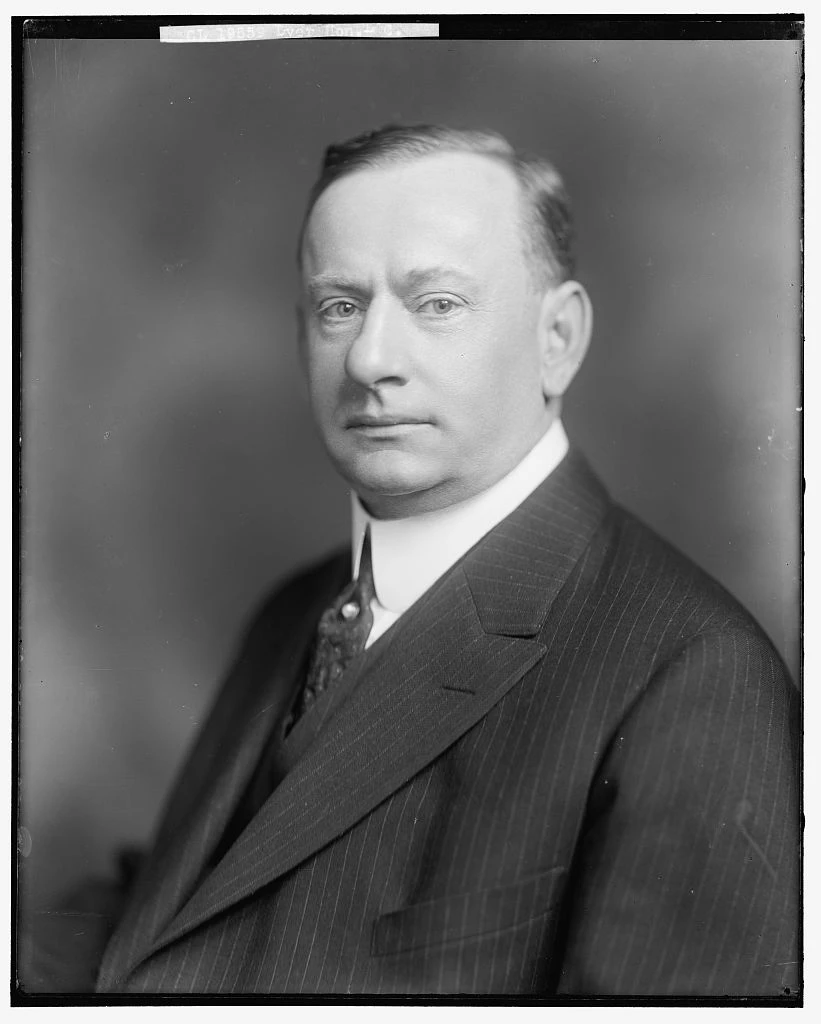
American history gives us a much grimmer example. On January 26, 1922, several hundred Black spectators crowded the House gallery for debate on Leonidas Dyer’s anti-lynching bill. Some cheered despite the gallery rules. The House passed it, 230–119. The proposal would allow federal prosecution of lynchers and penalties for officials who failed to protect victims or prosecute their killers.
Then it reached the Senate. Southern Democrats blocked it with a filibuster, and Republican leaders declined to keep fighting for it. Dyer introduced anti-lynching legislation again in subsequent Congresses. The people asking for federal protection kept waiting.
That delay did not force the opponents to accommodate those people’s interests. It delivered the outcome they wanted: no federal anti-lynching law. The danger facing Black Americans did not just disappear simply because senators could not agree. For those resisting federal action, preventing a decision was an accomplishment. For those seeking protection, it was another failure.
A procedural obstacle earns its defense by the work it induces. If it pushes people to accommodate interests they would otherwise ignore, it may improve the decision. If it allows someone to block a decision indefinitely while gaining attention from the stalemate, slowness alone is no evidence of wisdom.
There is still something to build on. Research from the Center for Effective Lawmaking, using data from 1973 through 2016, found that members who attracted a larger share of cosponsors from the other party were more effective at moving their legislative proposals forward. Those who cosponsored across party lines were also more likely to receive that support in return.
When was the last time you heard about a bill with strong, named bipartisan support? Yeah, it’s been a while, and it’s getting rarer. But, it’s exactly the kind of work it takes to get bipartisan support that makes our elected representatives effective, and the fact that we’re seeing less of it is why we feel American politics is broken.
The research gives us a reason to take the less visible work seriously. Persuading someone from the other party can help a member move a proposal. A Congress that makes that effort matter has something to offer ambitious people besides another chance to be on television.
Working relationships still matter. We need ambition to have a credible route through that work. And members have responsibility for opening the route: they vote on their institution’s rules and its leadership. They aren’t spectators who happen to have unusually good seats.
The bargain we have to be willing to hear
Of course, all of this gives those of us outside Congress another task. We’re supposed to recognize good legislative work while doing our own work, taking care of our families, and occasionally thinking about something other than politics.
During my conversation with Yuval, I admitted that I wasn’t as informed a voter as I’d like to be. I have work and a family. And, the constant shouting in the media turns me off and makes it easier to disengage. I don’t think the answer is to tell everyone in my position to spend more evenings watching politicians shout.
But we can ask for a more useful account of what our representatives do. Choose an issue they say matters. Look for an explanation of what they tried, who they needed to work with, and what changed because of the effort. If they opposed a proposal, what harm did they prevent, and what alternative did they pursue? If leadership blocked them, what are they doing to give members more room to legislate? A newcomer won’t have a congressional record, but can still explain how they expect to turn a demand into action.
A serious answer might be disappointing. It might reveal a small achievement, an unresolved problem, or a concession we dislike. At least it gives us something to judge. A promise to keep fighting can leave the most important part unanswered: fighting toward what, and how will we know whether you’re getting there?
The more uncomfortable test comes when someone we supported actually reaches an agreement. We remember the promise. We may have defended it to a friend. Now our representative is standing beside someone we dislike and explaining why a smaller result is a victory.
It’s easy to feel played. Why did we put our confidence in this person if they were going to give something up? The politician who refused the deal has a much easier answer: they never stopped fighting for us.
Maybe the bargain really was a betrayal. We shouldn’t applaud automatically. We should expect the representative to explain the trade: what was gained, what was conceded, who bears the cost, and why this was better than the available alternatives. Then we have to be willing to hear the answer before deciding that the concession itself proves our trust was misplaced.
This matters before November 3, but it will matter after the votes are counted too. An election can replace the people in the seats. It can’t, by itself, make us stop rewarding an entertaining explanation for why the job remains undone.
If the only success we’ll reward is a politician returning with every demand intact, we should expect a lot of intact demands. And very little else.

This essay grew out of my conversation with Yuval Levin for The Unfolding Thought Podcast. The full conversation will appear in a forthcoming episode.
Notes and references
- The conversation. Yuval Levin on ambition, centralized power, and incentives for bargaining in The Unfolding Thought Podcast, especially 19:35–24:50. The water-system example is hypothetical.
- Rayburn and the Rules Committee. U.S. House historian, the 1961 expansion of the Rules Committee.
- Reform and leadership control. Congressional Research Service, The Evolving Congress (2014); and The Cannon Centenary Conference: The Changing Nature of the Speakership (2004), especially the Gingrich-era discussion.
- House amendments. Congressional Research Service, Offering an Amendment on the House Floor: Current Practice (2022).
- Johnson. Robert A. Caro, The Path to Power (1982), chapter 15 and chapters 31–33; Master of the Senate (2002), chapters 24–25.
- Online applause and constituent approval. Michael R. Kistner and colleagues, Measuring Partisanship and Representation in Online Congressional Communications, Center for Effective Lawmaking working paper (June 2025), especially the engagement analysis and Appendix J. The approval results are associations, not proof that negative attacks cause approval.
- A route to floor consideration. Congressional Research Service, The House Consensus Calendar: Principal Features and Practice in the 117th Congress (2021–2022).
- The Dyer bill. U.S. House historian, “Exile”; Library of Congress, “A Federal Law Against Lynchings”.
- Bargaining and legislative effectiveness. Center for Effective Lawmaking, “Are Bipartisan Lawmakers More Effective?”, drawing on the 1973–2016 Congresses.
- Cartoon reference. The dogs-at-a-computer illustration is an original riff on Peter Steiner’s 1993 New Yorker cartoon, “On the Internet, nobody knows you’re a dog.”